Wedding photography – Developing a personal style
I’ve been mulling a while now over a question someone asked me about how long I think it took to develop a personal style in photography.
“What does it take, and how many years do you think it generally takes a photographer to develop their own personal style, meaning, you can look at a photograph and know who took it. Not everyone would know, but some people could tell it’s your style. I think very few photographers actually have their own style and I’m curious what you think it took to get there.”
How long do I think it takes? A life-time. But that’s too glib an answer, even though I think it is a never-ending journey as a photographer – honing your style along with your technique, understanding and skill. So how does one develop a personal style in photography?
Now, the question wasn’t phrased about wedding photography per se, or about my own photography either – but I can more readily see how my style has changed over the past few years in terms of my wedding photography. It may be hugely presumptuous that I’d now even offer an opinion on this, especially because I know my own short-comings, and know where I need to improve and develop my own work. So if everyone reading this could be generous enough to allow me to describe how I see my style in (wedding) photography has developed, and what affected it over time:
My personal style in wedding photography
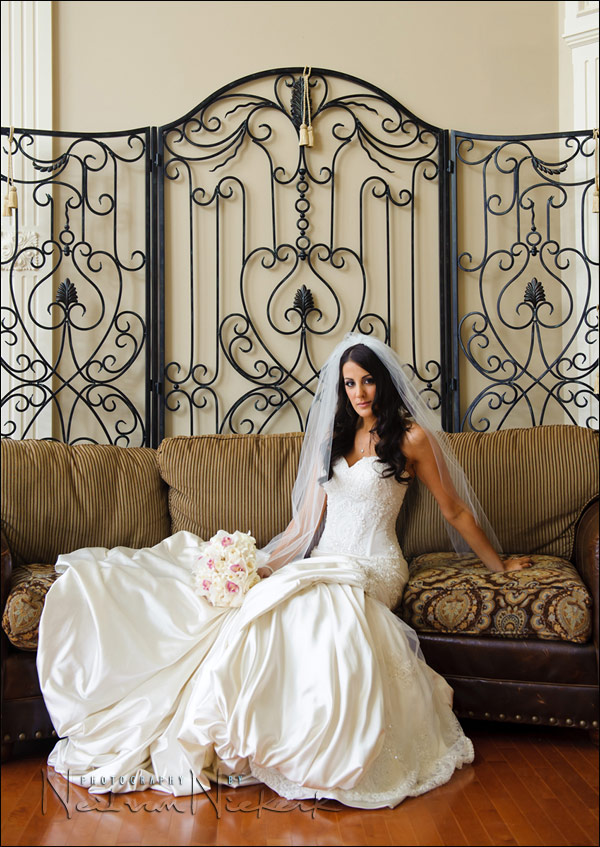
When I look at the selection of images for my Latest Work blog, or the images included in the albums on Facebook, a few things become apparent about my wedding photography – there is a simplicity in composition, and the lighting is clean and open. The photographs hopefully have a timeless style and elegance that draws the viewer in. I can recognize my own work by now for that specific look.
The photo at the top (with bounce flash), and this next image (with video light), are typical of my bridal portraits – uncluttered, stylish compositions.
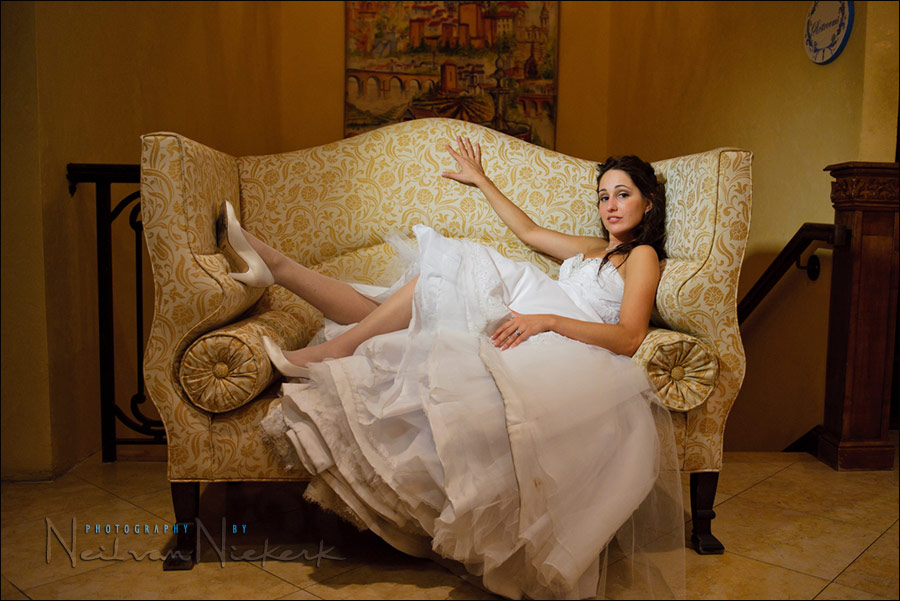
In all my photography – whether personal photography, or in photographing models, or my wedding photography – there are a few things I immediately try to control if possible:
- the background has to be uncluttered and has to be complementary. I try and eliminate everything from the frame that doesn’t add to the image. Simplify, simplify, simplify!
- clean, open lighting, whether on-camera bounce flash, off-camera flash, available light or video light. My lighting is rarely complex, and is usually just one or perhaps two light sources. Even though I use diverse lighting, the approach is nearly always the same – clean, open light.
- posing my subjects in a natural way that complements them, and is natural to their personality.
That is when I can direct my subjects. However, a large part of the wedding day is uncontrolled and unscripted and often borders on near chaos. Then it becomes a matter of anticipating events and moments, and anticipating how people will move into and out of your frame, and how they will respond.
Anticipation and timing in wedding photography
With practice and experience, it becomes easier to predict the flow of events, and know what to look out for. But this is actually a two-fold thing:
1. You have to have the ability to recognize when something looks good in the viewfinder.
You have to have that proverbial eye for this. I truly believe this is an instinctual thing for people with an artistic ability. While composition and such can be taught, I believe that this sensibility won’t be a natural thing if it has to be mechanically understood, instead of instinctively understood. It’s the difference between “aaah, I get it!” and someone mechanically trying to fit everything to the Rule of Thirds or the Golden Mean.
Finessing ones skill as a photographer, means a constant learning and re-learning by reading voraciously and by studying your own work and the work of others.
You can be taught what to look for. Such factors as:
– repetitive patterns which bring a simplicity to the image;
– leading lines;
– diagonal lines;
– balance;
– tension.
Once a photographer or artists has an emotional grasp of these elements, they are understood, and don’t have to be mechanically applied from memory.
There needs to be an intuitive and emotional reaction to your subject or scene. It has to be on the level of, “aaah, this looks good in my viewfinder!” rather than a mechanical compositing of elements within the frame.
We need to be artists, not technicians.
2. You have to know your cameras and equipment, and you have to know the fundamentals of photography.
You absolutely have to understand how shutter speed / aperture / ISO inter-relate. You absolutely have to understand how depth-of-field changes with aperture. And so on. There’s a long, never-ending list of these things. We’re all on a constant learning curve with this, and we can never be complacent.
We should never give ourselves excuses for not learning. “I have no idea how my camera works, LOL” Well, that’s just stupid self-indulgence.
You can not effectively capture those images you see if you are struggling with the controls of your camera, or handing it all over to the camera via Program mode.
“P” is for Professional?
Well, I use “M” for “I Know WTF I’m Doing”
Having a “passion for photography” is no replacement for knowledge, regardless of what those inspiring blog posts and workshops might be telling you.
You can not succeed while you’re making excuses!
A series of epiphanies
There were a few events and things over the years which had a huge effect on me, and changed everything for me as a wedding photographer:
1. Learning from the best
A pivotal experience for me was a seminar that I attended (circa 2004?), where Yervant and David A Williams teamed up for the day.
At the time I didn’t know who David A Williams was, but that soon changed. He has had a huge and long-lasting impact on me. There’s more than I can possibly do justice in a single paragraph. But I’d urge any serious photographer to search out his work and attend one of his Almost Alone seminars if possible. It will change you and it will change your photography. Guaranteed.
Back to Yervant. I went to this particular day-long seminar because I was truly impressed with his work. This was at a time when the Australians were creating massive sweeping changes in the stagnant traditional approach to wedding photography. Yervant has an amazing style – there’s a Fashion sensibility and story-telling motif throughout his work. His wedding albums are fascinating to see. An experience. With that in mind, I attended this seminar.
I was / am in awe of Yervant. But what brought me down, was my preconceived idea that he had a team of people working with him helping him set up and do the lighting and such. How wrong was I on that! During the seminar, it turns out that he works alone with just an assistant carrying a camera and a video light. Simplicity! I was shocked. Work as sensational as his, created just by working with his clients, the environment and working with the existing light, augmented with video light? Wow.
This was truly liberating for me. I didn’t need a team of people. I didn’t need a host of lighting equipment. It was all up to me. All I had to do was hone my skill in seeing and pre-visualising an idea. It was entirely up to me. There were no limitations but my own. Liberating! No more excuses. It really was within my and anyone else’s reach.
There is also Jerry Ghionis whose meteoric rise has rightfully put him at the top of the wedding photography field. If anyone is not familiar with his work, then you should make the effort to check him out, and attend one (or more) of his seminars and workshops. Jerry works in a similar style to Yervant in that his choice of equipment is not extravagant. He favors the 70-200mm f2.8 and works with minimal lighting equipment when on location. And often finds unusual ways to implement the available light. Sheer genius.
2. The photo gear is actually important!
One of the misleading platitudes in photography, is that equipment isn’t important. That it is all about the photographer’s ability. Now while the “either/or” discussion can rage on, it is trivial. It isn’t “either/or” … it is “and”. You have to have the abilities AND the equipment with better specifications and features that will enable you. Then the limitations are your own.
But the point where the equipment enables you, can often come at surprising times. It isn’t about the 10 frames a second capability that a camera has. It’s more than that, and it’s often more subtle than that. Here’s an example:
Where my approach to on-camera flash completely changed a number of years ago, was when I moved over from the Nikon system (and the SB-800 speedlight) to the Canon (and the 580 EX speedlite). The commonly held belief then was that Nikon had the superior flash system. But going from the SB-800 to the 580 EX had an immeasurable impact on my style as a photographer.
The reason is that the Canon 580 EX could swivel 180 degrees to either side, instead of stopping at the 90 degree point when rotating the flash head to the right. This makes a huge difference when bouncing flash with the camera held in a vertical position. Instead of bouncing flash into the ceiling above me – who’d put a softbox directly over someone’s head in the studio? – I could now bounce my flash behind me towards the direction I wanted my light to come from.
I can’t over-emphasise how important that realization was. I could bounce my flash towards the direction I wanted my light to come from. That changed everything for me in how I used on-camera flash.
The point of this discussion here, is that debating the differences between f1.2 and f1.4 is a distraction. Just make sure you have the best equipment you can afford. It need not be the Canon 85mm f1.2 in your bag. It could be the Canon 85mm f1.8 … but the f5.6 kit lens as your only lens, just isn’t viable. It will limit you.
Ultimately, I believe your equipment should be better than your own capabilities. Then you can grow as a photographer.
Oh, if I could have another minute on this soapbox:
Style in photography isn’t created or found by using a specific item as a constant gimmick (such as a tilt-shift lens), or using a specific Photoshop action set to give your images a certain defined look. That’s a side-track which is ultimately a dead-end. That’s not “style”. That’s just something you do.
3. Look elsewhere too
Look through Fashion magazines. Study the movies you watch. Take in elements from other fields of photography and art than just wedding photography.
David A Williams lays emphasis during part of his seminar on the importance of this – looking at the work of the master painters. There’s much to learn there in composition and light.
4. Emotional impact is essential
At the heart of wedding photography is the notion that we should capture photographs which have emotional impact. Great composition, excelling timing, good lighting, and everything else that we do as photographers – all these things should be the underlying basis in creating images with emotional impact.
Individual images might just be supporting an overall story that we’re telling through our photos, but when combined as a collection of images, there needs to be a connection with the person viewing the images. Inevitably this traces back to the day’s narrative – the photo-journalism of telling the story of the event.
My top 10 tips in developing a personal style in photography
In writing articles for this site, I always start with an idea of where I want to go with a topic, but they rarely end up along the lines of a “10 tips to develop a personal style” type of article. Regular followers of the Tangents site will know this by now – the articles and posts here are more like meandering conversations than bulletin point tips. And this time again I hope something useful and even revelatory could be found.
I started working as a full-time professional photographer here in the USA during 2002. It’s been a never-ending learning curve. In a way this blog – Tangents / planet neil – relays the arc of where I am in my own photography. There’s a forward momentum to which I don’t see the end in sight yet. I’ve been honored in that there have been photographers following this blog which have stayed for the ride.
All this brings us back to the original question – how long does it take to develop a personal style in photography? I really have no clear idea. 5 years? 10 years? 15 years?
I believe each point in your personal journey as a photographer will see you with an evolving personal style, where you can see elements within your own photography which are clearly how *you* do things. A personal style will develop … and continue to finesse and even change.
Other articles on wedding photography
Thanks so much Neil, I am an avid fan of yours. keep following each and every blog in Neil Tangent. Please keep up the good work. Not all pro’s are so willing to share knowledge. Keep it up man!
Incredible post, I have to re-read it more times and memorize it. I’m always tempted in moments like this to say “it’s the best post for a while”, but there are so many, that the conclusion is… you are the best, with every single post you wrote.
Many thanks and so much respect!
Wow Neil, this is a must read for every photographer. Thanks for sharing your Gift, Talent, Knowledge, and Wisdom on photography. It would be great to see this entry turn into a movie. What actor would you want to play you? or would you play yourself. Like the movie said, “you want Fame, well you’ll start paying it off in sweat.” Thanks for sharing.
Neil
Thanks for taking time to going into detail about your experiences. I am sure that many photographers keep such useful information close to their chest.
Martian
“We need to be artists, not technicians.”
that line alone stood out to me, I am so many times jealous of those who are so technical in their thinking. Knowing the ins and outs of photography is key, but having the “eye” and knowing how to capture the right moment will get you what you need. I have seen some photographers images that are technically correct, but capture the wrong moment, the wrong expressions and it just doesn’t work.
I think the best photographers will be those who can equally well balance the analytical aspect of photography (and the understanding and true grasp of what is going on) .. with an artistic sensibility.
It needs both aspects. But the dry, analytical paint-by-numbers method of doing photographic composition … that’s just not going to bring forth truly creative work. It will remain competent photography, instead of inspiring and artistic photography.
Neil vN
Thanks for answering my question with such deep thought. I really appreciate that you took the time to think it through and answer from your heart, with appropriate Neil snark. I love this: “Style in photography isn’t created or found by using a specific item as a constant gimmick (such as a tilt-shift lens), or using a specific Photoshop action set to give your images a certain defined look. That’s a side-track which is ultimately a dead-end. That’s not “style”. That’s just something you do.” That struck me as very interesting.
I am on my journey to figure out who I am as a photographer at the same time as developing my technical skill. I think the kinds of things I like to portray in photographs are some sort of tension or emotion. While I love beautiful pictures of smiling kids, my heart is really drawn to people with “interesting” expressions that draw you in – anger, solitude, pensiveness, satisfaction. I think my style will somehow come from that eventually. thanks again for sharing another piece of yourself with us, your fans.
Such a wonderful post, Neil! I am constantly amazed by your artistry and willingness to share your techniques and ideas. I learn something every time I stop by ‘tangents.’ Thank you!
Thanks,Neil! This post really made me THINK. I am still new to photography and was introduced to you recently on CM. I won your first book and love it and am looking forward to starting your second. I do shoot on M (lol) and now I am working hard on developing my art. This post will be bookmarked for me to read again and again. Thank you so much for sharing your art and your wisdom.
My first read of your blog and a wonderful article! Thanks for sharing. I still feel very much that I’m finding my own style, and I hope that I never stop feeling that I can continue to learn, adapt and refine.
Thanks for sharing your knowledge and opinions on such topics. Your blog is always a good read.
Maybe you should do a quiz again, with photos you took and photos from other photographers, and see if we can guess which ones are yours? :-)
Fantastic post Neil – love your work and your meanderings – I’ve sure learnt alot from them!! Gena D (Johannesburg, south africa)
Thank you Neil.
I have been following your blog for quite some time and I will continue to do so!
“Ultimately, I believe your equipment should be better than your own capabilities. Then you can grow as a photographer.”
This one really made a lot of sense to me. There are times where I am feeling my capabilities have pushed the equipment I have had for the past couple of years and that I need to move up to something better so I can push myself. There are things I see that I just can not reproduce with the equipment I have no matter how hard I try.
On the other end of the spectrum though, I see a lot of people buy really expensive equipment and don’t know how to use it. They think that by having something expensive, they can avoid learning how to use what they have and let the equipment do all of the work. Usually they have it in Auto or P mode.
Thank you for the time, patience and passion you have put in this post and all others in this amazing blog.
Thank you!
Hi Neil,
This is a great post, since i’m having trouble to find a “style” to my photographical expression of moments in someones life.
I learned my photography mostly through web!(your site made a huge impact on my photography)When I look at the images from various well known photographers, I could see a similar pattern or trend they all seem to follow. And most of their works looks similar(to me)!
SO, I started concenterating more to catch the personality and charecter of the couples I photograph, which gave a entire different “style” of photographs each time.
Do you think this approch is right? or would work well in the long run!
I’m asking this because the wedding(portrat session with the couple) I did the last was a disaster! The engagement session went really great with the couple since they were open to try nearly everything and I got good images. But for the wedding the Bride was not willing to do anything creative! She was afraid of her dress getting spots, makeup getting messedup etc..etc!!! She would’nt even kiss the groom. I got in serious trouble since I was not pre planned with posing them in a certian way. So I ended up getting some boring images that you’d see anywhere.
How do you do this! or deal with situation like this? Do you always have a readymade plane?
Thank you for your valuable site.
Regards,
Gracious
Sh*, I’m seriously software developer so I have to practice harder to be an artist :). I totally agree with most of your experiences. Thanks!
Love the site. So much great info here. Just watched your seminar “Just Give Me The F-Stop” on YouTube. It cleared up ALL frustrations about flash photography. Thanks, Neil.
Neil,
Another great, thought-provoking post. I am inspired by your work and am already seeing an improvement in my own photography.
Two things impress me the most about you: 1. You truly have the heart of a teacher. Your explanations show mastery of your craft but are also inspiring and easy to implement. This is a rare gift and I am deeply grateful to you for sharing it with us.
2. Your generosity. This obviously influences #1, but to hear you reference your mentors so openly and graciously is heart warming. There is no greater praise than praise from the praise-worthy.
Thank you for sharing and teaching so freely!!!
Hi Neil, Can you help me to understand Flash head zoom, and flash Guide numbers. For a while now i have been trying to get a better understanding of these two things, but no such luck. thanks in advance for your help. Adrian“`
Hey Neil… I somehow knew there was an engineer hiding in you somewhere :-).
There’s nothing derogatory in your article, on the contrary, you’re saying everything with a great deal of grace and honesty, an attitude that permeates thru the whole body of work your site showcases. There’s no wonder you have so many followers (me included).
A bit of formal training would not hurt anyone and when I say formal, I’m thinking more of getting one familiar with the concepts of composition and visualizing, not necessarily going to school or attending art class as pre-requisite.
The greatest example of this is perhaps Picasso, the man that broke every single rule in the book. Have a look at his early work, his Blue Period or Rose Period and there’s a pretty strong classical, El Greco influence in them. He knew them rules very well and he also knew the path to self discovery begins with the discovery and study of others before him.
Learning how to turn my flash around, proper bounce technique and a good understanding of the principle behind it after discovering your blog back in 2003 (? I think it was) is one of the most valuable lessons I’ve ever learned, one that made a huge difference in the quality of my work.
Any time you’re in Toronto, let me back up my thanks with a couple of beers, OK?
Gracious,
One of the things I try when the bride becomes “apprehensive”, I have the groom whisper sweet nothings in her ear :-). That obviously tickles, makes her laugh and loosens up the atmosphere a bit. You can snatch a few very interesting shots in the process. You can have the groom trying to kiss the bride but instruct the bride to avoid it… this also might lead to something. If anything fails, selective focus with bride and groom alternately in focus is something to try (that’s a bit of a “bread and butter” kind of shot anyway). Walking hand in hand will work too…
But what actually works the best for me is an easy going attitude, easing off the couple into the session with simple poses and at times snatching them Yervant style and offering them a drink. (Yes, I love Yervant’s work as well).
The author Malcolm Gladwell in his book “Outliers” defines the “10,000-hours Rule”, claiming:
The key to success in any field is a matter of practicing a specific task for a total of around 10,000 hours.
Awesome post Neil. Thank you.
Fantastic post, Neil. I love your approach and I agree that studying from the best can only make me a better photographer. That’s why I studied with you! Seriously, between the books, the tangents and our one-on-one session last month, I feel I’ve grown immeasurably as a photographer. Thank you!
Bogdan,
Thankyou for yout advise and tipps. I like the “whisper” technique, its new to me and I’ll give it atry next time.
The mistake I did here was that I got into “panic” when I noticed that the bride is not co-operating! Since I’m not much experianced(was my 4th wedding)made it really hard for me.
Another “mistake” was that, I let them(groom) choose the location for the shoot and didn’t looked at it before the shoot!
But its all about learning and sites like these are a blessing.
regards,
Gracious
Well, not everybody can be a physicist (tongue in cheek). I studied Physics and know exactly what you refer to, there has to be a heart and soul aspect to photography, especially weddings. I have been a little nervous about my first solo wedding coming up, at the beach. I want to thank you for this post particularly, (still working through the others) as it told me, simplicity and a eye for scene are critical aspects. I needed to read this post.
Thank you.
Another great post Neil. Thank you so much!
Neil,
‘You can not succeed while you’re making excuses!’ – Stoped me dead in my tracks that did… my brain is going to hurt by the time i finish mulling that one over.
Awesome post and appreciate you sharing your honest feelings and thoughts. This subject would truly make an exceptional book (hint, hint).
Its the mental aspect of photography that I feel is the biggest challenge. Questioning and changing the way that I perceive, interpret and interact with the world around me. It certainly doesn’t stop when I put the camera down.
Thanks again
Chris
A brilliantly written post in which you absolutely hit the nail on the head. “You cannot succeed while you’re making excuses” , spot on! Learning about f-stops, shutter speeds, understanding light etc. all these things are essential if you’re going to be able to create work of real impact. If you are going to ask someone to trust you to take their wedding pictures then absolutely you must know your craft inside and out. Hiding behind the idea that somehow you are an artist and not interested in such things is exactly as you say, an excuse.
What a great post. Everything said is so true. It doesn’t matter if you know all the rules about taking a photo if you don’t know when to press the shutter. Have the right equipment is so important. Still remember one of my first wedding where my fastest lens was F4 and I found myself in a dark church without a flash. I was using a 20D and I just cranked up to the highest ISO possible. I tried to clean up the noise in post and most of those shots became B+W.
Great post Neil! Always love to hear your insights, even when they cut deep ;)
On the bright side – its important to know where you ARE when you’re trying to move towards a certain destination!
Thanks Neil!
First time on the site and I’ll be back! Inspiring and well written! Thanks for mentioning placing the flash head to face towad the back ( I always find someone looking at me strangely, and have never seen another photographer do it…bit it works..so hey)
Great post Neil, i love your take on things and the ideas you share, style is important to have and not too easy to define
First time on your site. Great web site!
A thought about how style is a reflection of our inner cultivated self and our knowledge of trends in art and of art history. With the birth of digital photography over the past decade wedding photography has changed in what it was during the film days. We all agree that wedding photography is a specialized field of this art form, which is dedicated to snapping the most memorable moments in various creative ways. A photographer can take a preferred approach towards this subject. During the film days, not to say the period of vernacular photography, the traditional & static ‘posed’ ways were a sure shot the photographer’s economic staple. The digital age of photography saw a metamorphosis in wedding photography where we (photographers) are capable of banking on dynamic photography composed of various styles (black & white, geometric forms, architectural, photojournalism, imitating painters like Rembrant for portraits, Salvator Dali who played with long shadows, etc.) based purely on Carp Diem – where we not only seize the moment but capture the essence of it in an art form. Photographers are creating fabulous images with particular themes agreeable with the client – and many times client generated themes. There are cases where glamorous wedding photographs are captured in the studio. Today, people want to explore new and dynamic ideas, outside of the studio & away from static poses, which opens up many new, creative and artistic avenues for modern wedding photographers when recording memories, generating images and capturing the spirit and purity of that timeless essence of the moment. Creativity and the willingness to explore new manners and techniques, which often stem from our knowledge of the history of the arts, are important roots of the modern wedding photographer’s style
Hope this help you in your thought process of your photography style
Neil your style in my opinion is unique. If I just google photographers as a general search without being specific, I can spot your work just scrolling through thumbnails. It stands out. You always add something more that goes above and beyond your previous work. Which challenges me to go beyond. Always learn something new from your posts.