Flash Photography Techniques
Bouncing your flash ~ On-camera flash outdoors ~ Exposure metering

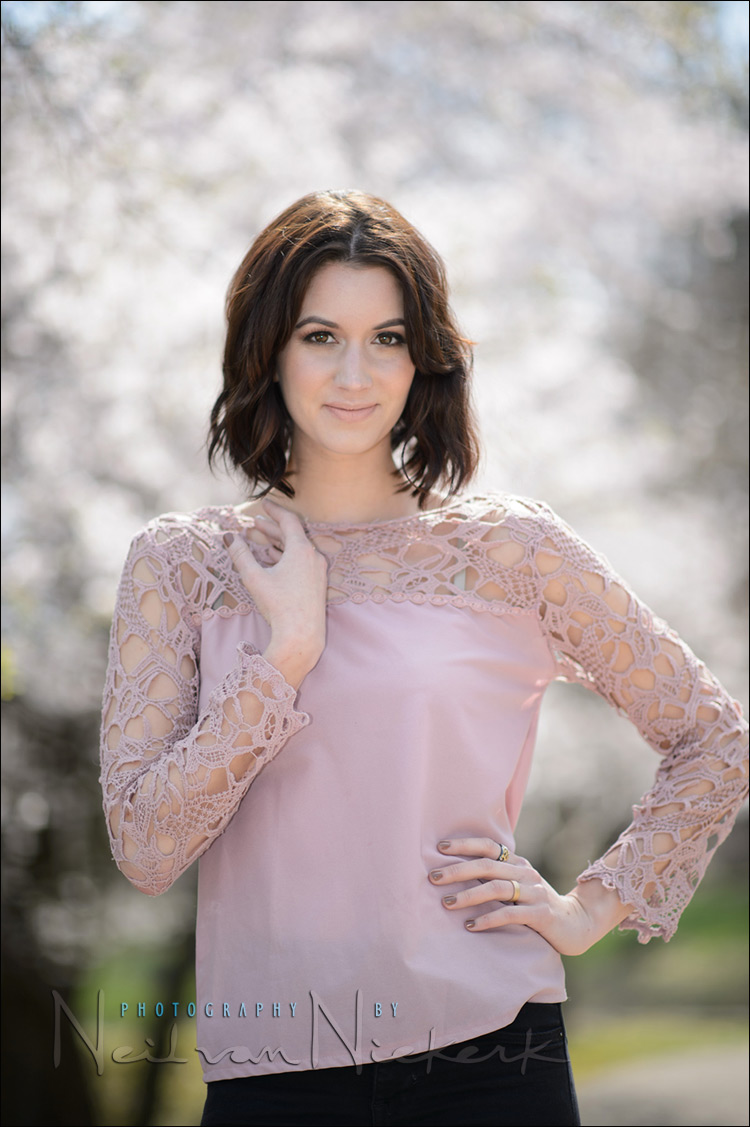
Using on-camera flash outdoors
Speaking very broadly, there are two ways of using on-camera flash outside – either as:
– a slight fill-flash, or as
– a brute light source to lift the shadow areas of a subject to the same level as the sunlit areas.
Of course, in between that, there is a wide spectrum of possibilities, but for simplicity of explanation, we will concentrate here on those two scenarios.
Metering correctly for ambient light is key here. It is important that you understand how shutter speed, aperture and ISO inter-relate. Then it becomes as simple as juggling the three inter-dependent controls – shutter speed, aperture and iso- and adding flash. TTL is most likely the easiest initially.
Here are our options with outdoor portrait lighting:
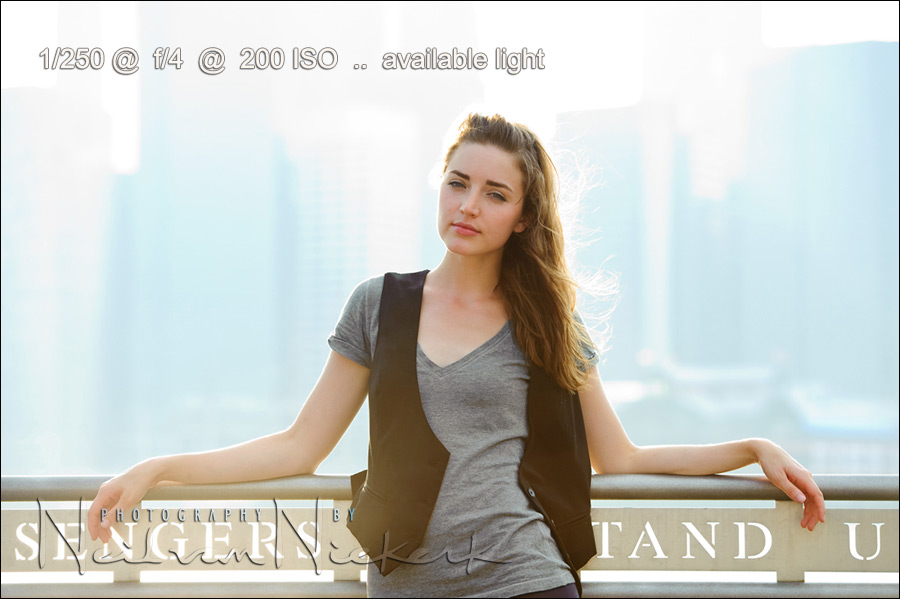
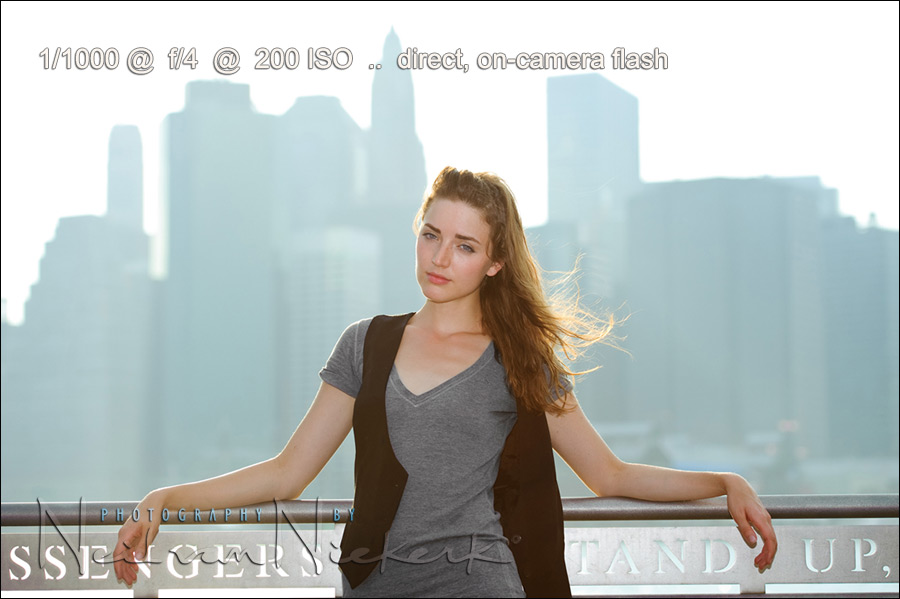
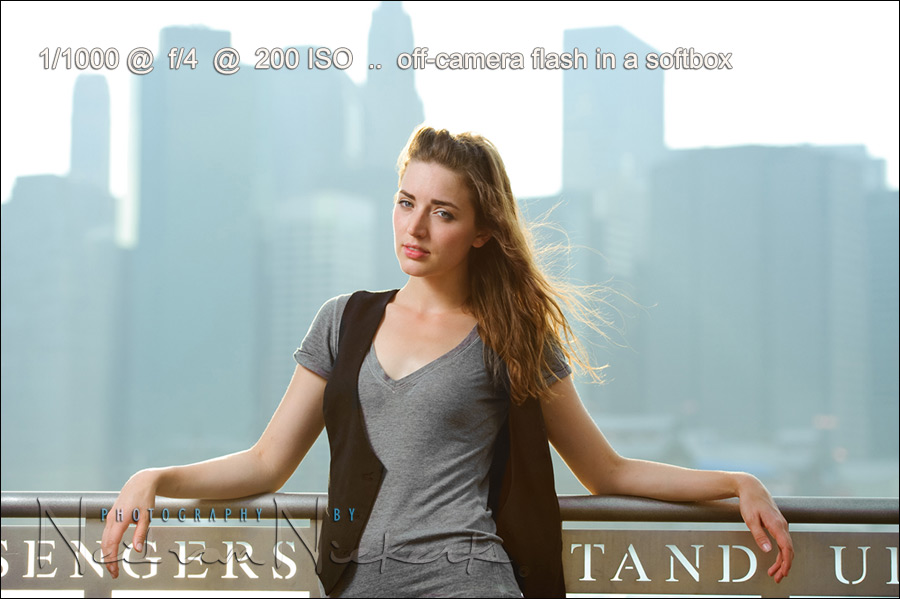
There, in a nutshell, we have three of our options when photographing portraits outside in bright light.
If I am limited and can’t use additional lighting, then the simplest is to have my subjects turn their back to the sun (or bright light). This way there is no squinting, and there is usually nice open light on my subject. It’s a very good work-around.
If I need to balance the exposure for my subject and the background, then I need to use additional lighting. Direct, on-camera flash does the job … but doesn’t look as good as the off-camera light which gives us directional light.
So, where possible, I will go for Off-Camera Flash (preferably diffused). But, in a pinch, direct on-camera flash might have to do. And this is what we are going to look at with the example images in this tutorial:
Direction & Quality of Light
I wanted to distill the essence of what we, as photographers, work with – light! Before we can truly grasp on-camera flash and off-camera flash, and really, any kind of photography, we have to be aware of the direction and quality of light. We need to observe the light that we have, and then decide how best to use it, or enhance it.
With this book, I try my best to share those “aha!” moments with you, and I do believe this book can make a difference to your photography.
The book is available on Amazon USA and Amazon UK, or can be ordered through Barnes & Nobles and other bookstores. The book is also available on the Apple iBook Store, as well as Amazon Kindle.
A.) On-camera fill-flash
The following photos are really simple in their execution. I metered correctly for the available light on my subject, Adrienne, and then shot with flash straight on – but my flash exposure compensation was dialed down.
The idea here is to just use the flash to lift the shadows, and avoid shadows under the subject’s eyebrows. The flash should ideally be imperceptible, and is really only used as fill-light.
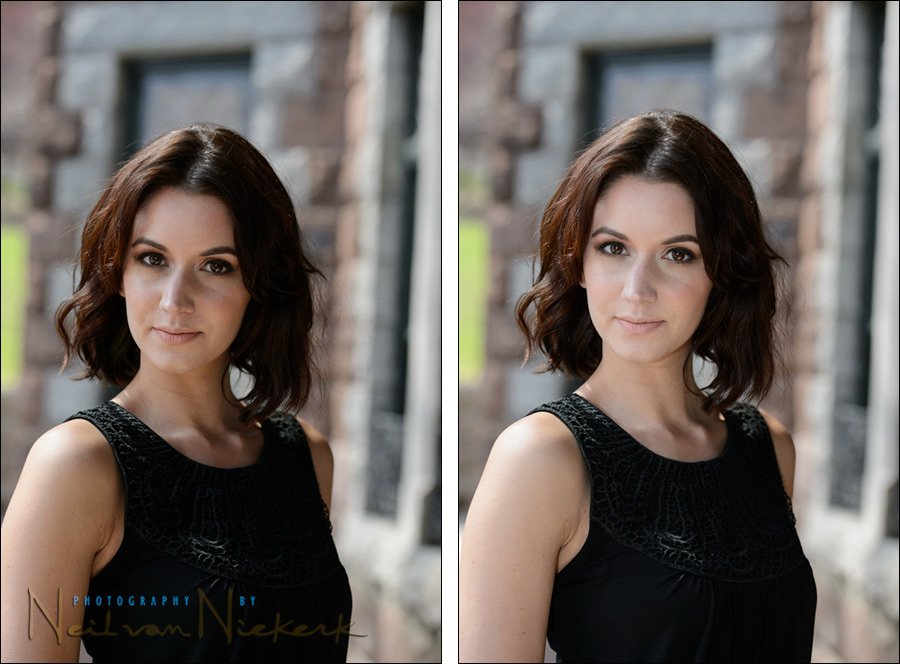
- Camera settings & photo gear (or equivalents) used:
- LEFT: 1/250 @ f/3.5 @ 100 ISO … no flash
- RIGHT: 1/250 @ f/3.5 @ 100 ISO … TTL flash at -1 FEC; (direct, on-camera flash)
- Nikon SB-910 Speedlight /equivalent Canon 600EX-RT Speedlite (affiliate links)
- Nikon 70-200mm f2.8 AF-S VR II /equivalent Canon EF 70-200mm f/2.8L IS II (affiliate links)
Fill-flash will help you control the contrast in your scenes and on your subjects. When doing so it’s important to maintain a good relationship between the ambient light and the flash. If you do so, the image could look quite natural — almost as if flash was not used at all.
Here I used a bit of fill-flash at -1 FEC. I could’ve used other settings for the flash exposure compensation (FEC) as well. Check this article – On-camera TTL fill-flash – for further detailed explanation with examples.
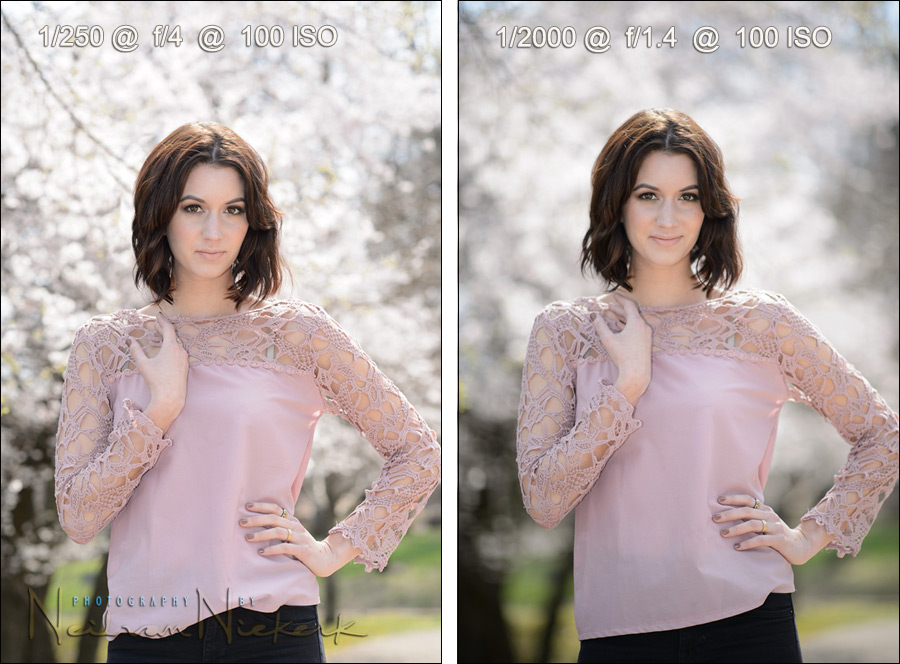
- Camera settings & photo gear (or equivalents) used:
- LEFT: 1/250 @ f/4 @ 100 ISO … on-camera fill-flash; TTL at -1 FEC
- RIGHT: 1/2000 @ f/1.4 @ 100 ISO … on-camera fill-flash; TTL at -1 FEC
- Nikon SB-910 Speedlight /equivalent Canon 600EX-RT Speedlite (affiliate links)
- Nikon AF-S 85mm f/1.4G /equivalent Canon EF 85mm f/1.2L II USM (affiliate links)
With the left-hand image, I used maximum flash sync speed. There’s a specific reason for that, which is explained in that linked tutorial. For the right-hand image, I went into high-speed flash sync (HSS) to get that shallow depth-of-field.
But images had direct, on-camera flash as fill light. I don’t often use a diffuser of any kind when I shoot outside with direct flash (as fill flash). The reason is that we only get softer light by creating a much larger light source. Using a generic light modifier on the front of the flash does not create a larger light source. It is therefore just simpler to use the flash directly—straight-on and without a diffuser — and dial my flash compensation down. Very often I work around -2 or -3 EV compensation on my flash.
If you prefer to use a small softbox on your flash, then it will definitely help in minimizing that hard flash shadow on your subject. Here you have to balance the need to work with less cumbersome gear, or have a (possibly incremental) change in how flattering the light of your flash appears.
On-Camera Flash Photography – revised edition
This book is explains a cohesive and thorough approach to getting the best from your on-camera speedlight.
Particular care was taken to present it all with a logical flow that will help any photographer attain a better understanding of flash photography.
You can either purchase a copy via Amazon USA and Amazon UK, or can be ordered through Barnes & Nobles and other bookstores. The book is also available on the Apple iBook Store, as well as Amazon Kindle. Also check out the Amazon Kindle store.
Learn more about how the cover image was shot.
B.) On-camera flash outdoors, as main source of light
With the examples above, we used subtle fill-flash, so the flash, even though direct and un-diffused, wouldn’t be all that noticeable. But we often find ourselves in situations where we have to rely on direct on-camera flash outdoors.
Let’s look at another example. Here I purposely positioned Adrienne part-way under an arch of this building, so that the light is uneven on her. No splashes of sunshine on her, just uneven and unflattering light on her face.
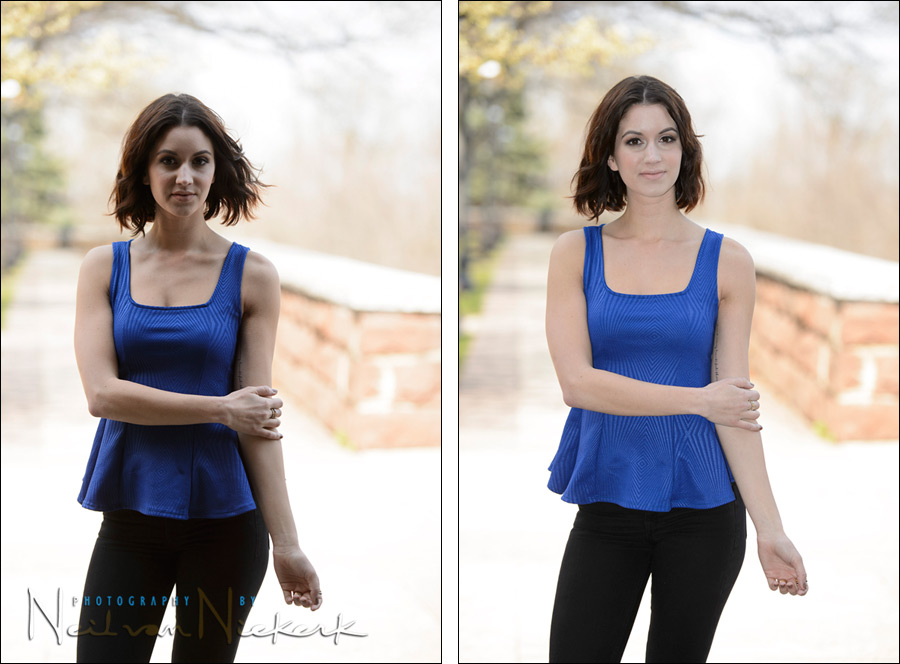
- Camera settings & photo gear (or equivalents) used:
- LEFT: 1/250 @ f/3.2 @ 100 ISO … no flash
- RIGHT: 1/250 @ f/3.2 @ 100 ISO … TTL flash at 0 FEC; (direct, on-camera flash)
- Nikon SB-910 Speedlight /equivalent Canon 600EX-RT Speedlite (affiliate links)
- Nikon 70-200mm f2.8 AF-S VR II /equivalent Canon EF 70-200mm f/2.8L IS II (affiliate links)
Direct, on-camera fill-flash immediately improves how this simple portait looks. Here I used direct on-camera flash without diffusion. A small softbox on the flash would’ve been helpful here in minimizing the shadow of the flash, but as it is, even direct fill-flash helps considerably in improving the photo.
In this specific scenario, the most important setting was the shutter speed of 1/250 second (the maximum flash-sync speed for this specific camera). The other two settings, ISO and aperture, hinged on the choice of shutter speed, taking the ambient light into account. The reason for this is that I was working in bright conditions and wanted the most efficient use of my flash.
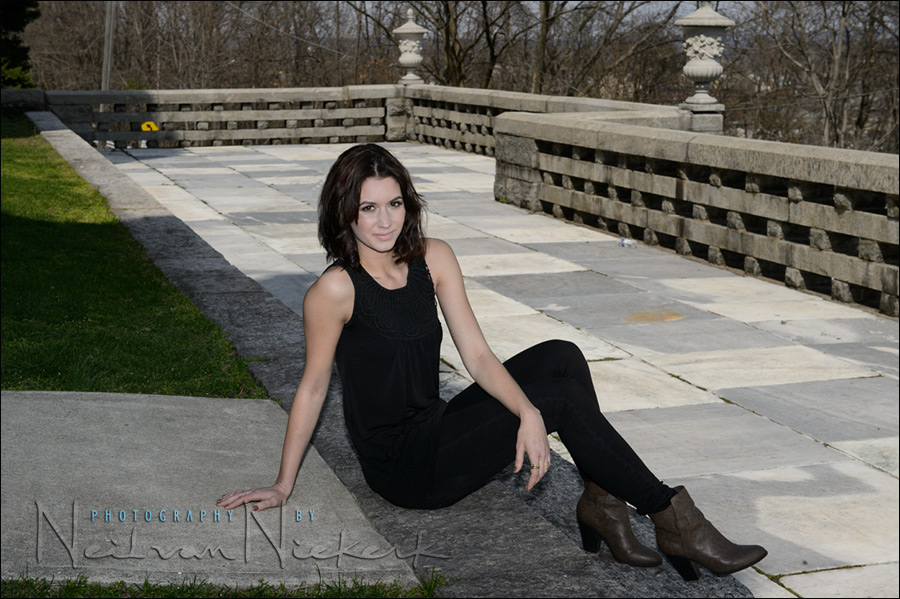
- Camera settings & photo gear (or equivalents) used:
- 1/250 @ f/11 @ 100 ISO … full-power manual flash (distance via Guide Number)
- Nikon SB-910 Speedlight /equivalent Canon 600EX-RT Speedlite (affiliate links)
- Nikon 24-70mm f2.8G AF-S /equivalent Canon 24-70mm f/2.8L II (affiliate links)
This photo was taken using full power manual flash to match the sun-lit background. I stood approximately 10 feet away from Adrienne, knowing that the flash’s maximum output would allow f/11 at 10 feet. This maximum output is indicated by the flash’s Guide Number. GN = distance * f-stop
The Guide Number of your flash is an indication of the power of your flash – how much light it can deliver. Your flash’s Guide Number (GN) is determined at 100 ISO, when it gives correct exposure at a certain distance, multiplied by the f-stop. It sounds like a crazy way to just come up with a number, but it works for us!
For a more in-depth discussion of how to use the Guide Number in bright daylight:
Applying the Sunny 16 Rule & Flash Guide Number.
Related articles
- Manual flash vs. TTL flash
- On-camera TTL fill-flash
- Photographing in hard sunlight with On-Camera Flash
- Tutorial: balancing flash and ambient exposure
- Applying the Sunny 16 Rule & Flash Guide Number
- tutorial: High-speed flash sync (HSS)
- tutorial: Maximum flash sync speed
- Manual off-camera fill-flash, controlling contrast
 next section: Exposure metering
Help support this website
If you find these articles of value, please support this website by using these Amazon and B&H affiliate links to order your photo gear.
I also offer photography workshops and tutoring sessions. There are also video tutorials, which are online workshops on photography.
Join us on the Tangents Facebook group for further discussions.
Neil vN
Books by Neil van Niekerk
Your work is very superior to others and with your own style. Very nice.
I have a group shoot of 50 people in a class reunion. I have a D700 w/ 24-70mm and 1 sb900. What camera settngs and flash settings should I use? should flash be on camera or remote? I have a on flash diffuser that came w/ SB900 or should I use bounce card? This will be shot outdoors and the forecast for this Saturday will be 74F partly cloudy and winds 8 mph.
Could you give me some advice?
Thank You,
Erik
Erik, with this scenario, you’d base your exposure on the ambient light. I can’t give specific settings since light varies from situaiton to situation, and day to day and time of day.
The one setting I can give you – maximum sync speed.
You absolutely have to be aware of the importance of this, and why this would be the sweet spot to use when using flash in daylight.
Off-camera flash vs direct fill-flash .. this too depends on the lighting situation on the day, and is something you’d have to adapt to at the time. No one can give you specific advice that would cover all situations. That would be an entire book on light and flash, or a website is devoted to flash and lighting.
Hi Neil,
I have a Nikon D300 and SB-900 and am wanting to use it in an abandoned building for a fashion shoot,
I know its not easy to say what the settings will be due to light change, location etc but have you got any advice on how to set the exposure up etc.
I will be using a single flash gun. I also have an Infra-red trigger and of course on board flash.
Thanks
Dave
Dave .. this entire website is filled with articles on that subject, but here is a good start .. so, what are your camera settings?
Hi Neil,
Been an avid reader of your site for quite sometime. Anyway, I’m still trying to get my head around the outdoor flash thing. I live in the Philippines so sunlight can be pretty harsh except for the early morning or late afternoon light. Now trying to get nice photos when I’m at the beach can be a challenge. Of course these are pretty much candids for personal use and so I’m restricted to on-camera flash since I’m moving about quite a lot. I find that the only alternative is to use HSS. Under the harsh afternoon sun, I usually get readings of ISO 100, SS1000, f.8-10. Trying to blur the background by opening up my aperture just raises the shutter speed. SO, using max synch seems to be out of the question. Any ideas? Oh, btw I use a 30D and a 580 EX.
Joey .. you’re stuck in an awkward spot with that scenario. The bright sunlight dictates certain settings to you .. and you have a ceiling of maximum sync speed to get the most efficiency from your flashgun.
Since you lose at least half your flash’s power by going to HSS, but need the narrower DoF, I would suggest ganging up two or more speedlights and in that way getting enough power in bright daylight … and still get narrow DoF.
“I set my camera to expose for ambient light”
1. Please explain just how you do this.
2. Is the difference between fill light and full light from the on-camera flash, that fill flash is dialed down to something like -3 compensation, and full light is dialed up to about +3?
Many thanks
Hi there Lydia ..
1. There are a number of ways how you can get to correct / good exposure settings, and they are covered specifically in the next section of this tutorial. A good start would be to look at what your camera’s meter is telling you.
2. Lydia .. your flash exposure compensation will have a radical influence on your exposure. Try it. Photograph a teddy-bear on a barstool in your living room, and see what -3ev / 0ev / +3ev does. In fact, work the entire range in full stop settings.
At some level you can only read so much about this stuff .. and then you actually have to do it, and try it out yourself.
Hi again!
I do not shoot RAW because I do not know how to process the images afterwards. So, what should I set my WB to when shooting in ambient light with flash? Thanks,
Genevieve
Genevieve .. editing a RAW image is easier and faster than editing a JPG .. and you have more latitude in exposure and WB corrections. There really is no excuse or reason not to shoot in RAW, especially with the price of memory cards and hard drives dropping.
I can’t give you specific advice about WB settings, since the scenarios we will encounter vary so much.
Hello,
I was wondering something. You say you metered correctly for the available light. So i guess you mean the exposure. When i meter my exposure in daylight it often is 1/30 – 1/60. How come you can get numbers like 1/250 ?
Kevin
Kevin, I get there by juggling my ISO and aperture to give me a higher shutter speed.
Here’s more on exposure metering, and using flash with ambient light.
There are also specific reasons why I am at 1/250th quite often. It is maximum flash sync speed for my camera.
Neil, you use CTS gel with your Quantums just as you do with your speedlights?
…then you never use cts gel when you work outdoors. Why?.
Hi Neil
A further question to the one Lydia already asked. When you say that’I set my camera to expose for ambient light, and then used flash which I dialed down.’ does that mean that you metered without taking the flash into consideration (ie meter whilst flash is turned off) or with the meter with flash turned on and as usual and then simply dial down flash (with camera adjusting automatically)?
Thank you for your help! I already learned heaps by reading my way through your website. Whilst I have read quite some photo books over the years, it took your website to get my photo-brain going again. Excellent work!
Switching your flash on could affect your camera’s metering. I know that with (most?) Nikon D-SLRs your camera’s built-in metering jumps by 1/3 stop when you switch your flash on.
In the end this doesn’t really have a great influence on the results – whether you meter with the flash on, or off. I usually switch my flash off, but actually could go either way on this when I shoot.
Hi Neil, are the photos shown on this page Photoshoped in anyway? If so, what sort of processing did you do to it?
Thanks alot for your help!
As mentioned on the intro page, “the images here had very little to no Photoshop work done to them. But I did correct the white balance, and fine-tune exposure and contrast for these photos, as part of my general raw workflow.”
Hi Neil,
I have a Nikon D90. But my question is, when you use direct flash outdoors with the FEC dialed down to -1.3 or -1.7, do you use a diffuser on your flash such as the nikon or stofen diffuser so the light from the flash is not harsh on the skin?
Thanks in advance,
Trina
Hi there Trina ..
When the light is fairly even on my subject, I most often just use straight-on direct flash from my speedlight. Since the FEC is dialled way down then, you can barely see that it was direct flash. An easy compromise.
But there are times I will use something to soften my flash and give me more directional light.
With the Nikon SB-900, I’ve found that I don’t quite get the subtle fill-flash that I am accostumed to with the Canon system. Then I do use the diffuser cup over the SB-900. It would appear that cutting the output from the flash in this way in this situation, allows the speedlight enough leeway to quench the flash output in time to give just that delicate touch of fill-flash.
As is usual, there isn’t one specific technique that works ALL the time. You have to adapt, guided by what you see, and what scenario you find yourself in.
Hallo,
Best website I’ve ever followed. I don’t know if my question is flash related but it is outdoor related.
When taking photos outdoors under or in between trees and other plants, I very often get this (very) slight green tint on the more exposed areas of the face. I guessed it is from reflections from lawns and or trees. It is hardly noticable but I would like to avoid it. I tried to correct it with temperature and tint combinations in RAW, but just can’t get the right balance. Will the flash help or do one use a special filter?
Hope it is a valid question and someone experienced it as well. Receiving your book in 2? days. Can’t wait.
Again, Excellent site.
Pieter
Pieter, that green tint from the reflection of light from the foliage is a real problem. If you can bring in a fair amount of flash, it does help solve the problem.
Alternately, the Photoshop solution is usually the way to deal with it. Select the area around which you want to remove the green, and then use the Hue / Saturation controls to reduce the amount of green selectively.
Hello Neil,
I have a D90 and 600. will shoot a wedding outdoors in april, starts 2pm or so. the couple may be under a gazebo thing. the two scenarios i’m expecting is under daylight, and one under the gazebo with daylight around it. i have the kit 18-105. may get a tamron 17-50 f2.8 heard it’s decent. would like to get mostly shallow dof shots. doing it for free, may be good practice for me.
btw, ordrered the CTS gels and a stofen. if the reception is gonna be indoors, i’m reading up on it. but kinda lost for the outdoor ceremony part.
now, i’m gonna be on manual. what settings do you recommend? what would i anticipate in both under daylight, and while in the gazebo?
Angel … I can’t give you specific settings. Just some general guidelines.
But I can give you some general advice on dealing with hard sunlight.
Hi Neil. Love your website and your book. Thanks for what you do it is well appreciated. My question is on how to approach exposure at a wedding. I was told you almost always expose for the dress however you are saying to expose for the ambient ligth and then dial in the FEC on the flash. Does this method always works well for the dress? Does the same hold true for indoor shots? Thanks
Neil,
I’m working through your articles and just got your book a few weeks ago. You are a great teacher and an inspiration to us amateurs.
I have a question regarding your response to the Joey Server post above;
NvN: “Since you lose at least half your flash’s power by going to HSS, but need the narrower DoF, I would suggest ganging up two or more speedlights and in that way getting enough power in bright daylight … and still get narrow DoF”.
Would you ever consider using a single on-camera flash aimed directly at the subject with a 3-stop ND filter on the lens. This gives you f/4, 1/250 assuming ambient is around EV 15 (“sunny 16”). Of course if you need f/2.8 or wider, this is a different story.
Anthony … a ND filter would do that in theory. But it might prove difficult for the auto-focus system.
I recently bought a ND filter to check this out myself, so will write a report-back when I’ve done that.
Thanks Neil,
I never thought about an issue with the AF. I’ve played around with this set up shooting my 2 yr old running around a sunny CA beach in the early afternoon. I’ve had reasonable success but some OOF shots. There were too many variables to know for sure if it was the filter or just missed AF by the camera.
I look forward to your results.
Anthony
Neil,
When you say, “I set my camera to expose for ambient light, and then used flash which I dialed down.”
What exactly do you mean by dialed down. Are you talking abuut the meter in your camera, or on your flash?
Still trying to get the full ah-ha.
Thanks!
Silisia,
Not to speak for NvN, but that’s a fairly easy question to answer. Say you’ve got your camera in Manual mode and you’ve metered the scene for 1/200th @ f/8, with an ISO of 640 (just an example). This is your ambient light (this is the setting by which your camera will expose for 18% gray; if you have a white wedding dress and/or a black tuxedo as your subject, you may want to adjust your camera settings accordingly).
Your on-camera flash can then provide as much, or as little, light as you want it to. If you just want a little fill light to lift the shadows from beneath the eyes and nose, you can ‘dial down’ your flash output. That is (and this may take some slight reading of your flash manua, depending on what model flash you have), you can set your flash (in E-TTL or TTL mode) to -1, -2 or -3 (or any increment in between, in 1/3 increments), by using the buttons on the flash itself (or via the camera, if you’re using at least a 5D Mark II and a 580 EXII speedlite). If you’d like your flash to provide more light (for example, if your subjects’ backs are to the sun and you need a large burst of light to lend some detail to their shadowed faces), you can ‘dial up’ your flash in the same way as I described above (usually, with Canon speedlites, you will see a minus sign and a plus sign on the flash controls; these are how you dial up or down).
So here’s a way to see how this works: expose your image so the background comes out exactly as you want it to (check your LCD and histogram to make sure it’s perfect). Leave the flash off at this point. Turn on your flash and point it at the subject (this is assuming your subject is outdoors and you have nothing to bounce your flash-light off of; if you’re shooting indoors, by all means bounce that flash head (see more posts on this blog on how to do that). So, assuming you’re outdoors and you’ve got the scene metered how you want it, turn on your flash like I said and point it at your subject, leaving your flash in E-TTL or TTL mode, and fire off a few shots. If your subject appears too dark, dial up your flash a stop or so. If she appears too bright, dial it down.
Hi Neil, when flashhead at position directly to shoot indoor and you use stofen, have you dial down again you flash exposure like when you shoot outdoor? Thanks Neil
Ivan, I usually dial down the FEC when using flash outdoors as fill flash, as in this example:
On-camera fill-flash
Neil,
I have been using my D700 with SB600 on-camera in iTTL BL mode for outdoor fill-flash. Flash comp of -1.3 to -1.7 seems to be the sweet spot for me. Many times I have to resort to using the “P” mode when the lighting varies from chasing subjects around and it works pretty well – but not necessarily as expected.
So my question is related to how Nikon fill flash works with the automatic exposure modes. While in “P” mode, and I checked it in “A” mode as well, when the flash is in fill flash (BL) mode, the metered exposure is lower than pure ambient. For example, if I use a tripod and have flash turned off, the camera meters to say 200/8 and if I turn the flash on and it is in BL mode, the meter drops down to 200/11 or approximately 1 stop. With the flash turned on I can then duplicate the non-flash results by simply depressing the function button (Note: Since I shoot a lot in manual mode I have set my function button to “no flash” so I can check ambient exposure while the camera is up to my eye).
The result is that the background ambient is lowered around 1 stop and with flash compensation I can get the subject looking good. This seems to be about what I would try and accomplish in manual mode. I am not dissatisfied, just surprised and want to know if your experience is the same. I THOUGHT that ambient would not change and the the fill flash would be that which was necessary to bring the subject up the to the average exposure of the frame.
I like what is happening but don’t know if that is intended or if there is something wrong with my camera.
Thank you in advance for your thoughts.
Jeff
Jeff, it’s exactly because of this required involvement in HOW the camera and flash work in the Auto modes, that I shoot only in Manual exposure mode in my camera. Then the camera behaves how *I* want it to, and I don’t have to second-quess the various algorithms that the camera engineers wrote.
Now I just have to figure out how TTL works for the one mode – manual metering mode. With that fixed base, the variable nature of TTL flash becomes just a little easier to predict and get a handle on.
So, in short, I have no idea how my camera responds in an any of its Auto modes when I use TTL flash. And I don’t have much incentive to learn all that.
Neil,
Thanks for the quick response. Whenever possible, I too shoot in M mode when using flash. I just want to add that even under Manual mode, the camera meter is making s similar adjustment. For example, if I tripod my D700 with my SB-600 mounted but not turned on using a scene with bright background and shadowed foreground (a classic shot for fill flash) and adjust (matrix metering) the camera meter until it shows perfect exposure I get 1/200 and F6.3 at ISO 200. Without touching the camera, if I turn on the flash, the meter will now show 2/3rds of a stop over-exposed. The meter in any mode seems to be taking into account the projected effect of having the fill flash. It makes sense but not what I expected. The result is that in Manual Mode I would generally dial down the exposure and get a pleasing picture. The same effect happens automatically in P mode which is obviously tied to the same meter.
By the way, the shots on your website are just incredible. You clearly have mastered lighting techniques!
Jeff
The camera will have to take into account the effect of fill-flash, and adjust its metering accordingly.
And thank you for the kind compliments.
let me just say I’m a OCF flash newbie. But one thing that confuses me is where you say:
Metering correctly for ambient light is key here. “I metered correctly for the available light, and then shot with flash straight on”
I usually shoot by aperature for shallow DOF, and let the shutter fall where it may taking into account subject movement. If I meter for the ambient light outdoors that typically puts my SS speed well above the max sync speed, so the only thing I can do is close down my aperature, right? I feel like I’m loosing creative control of the aperature w/ OCF.
Another thing I noticed when shooting ETTL is that the recycle time was SO slooow. I decided to test how long it was taking and got a range betweem 10-18 seconds. That’s a long time to wait for your next picture, especially when things are moving fast, like with children, or at a wedding. Again, maybe I’m doing something wrong??
Donna, in that case, since you are using flash only as fill light, why not go to high speed flash sync and get the shallow depth of field you need?
Regarding the slow recycle time, sound like you need a battery pack for your flash.
Hi Neil,
Your flash guide was the first one i learned from since getting my first DSLR in 2006. Thank you very much!
I have some questions regarding fill flash for Nikon. I recently migrated from Canon (pentax before that), to full frame D700. I like to use apperture-priority mode for about 90% of my shooting, especially outdoors. What I found out for Nikon, when in Av mode, I noticed that with my sb900 turned on and autoFP & BL selected, the camera will automatically balance the shutter and flash output. Normally the shutter will be a bit faster, turn off the flash and the shutter will be slower I have noticed. Which is unlike in Canon, the shutter will remain and the flash will auto expose as fill flash. I like the Canon approach in fill flash more since I want the camera meter not to change when the flash in on but only the flash will meter as required to fill the photo.
Is there any way to approach Nikon fill flash to mimic Canon? What is the best approach in doing fill flash in Av mode for Nikon?
Thanks!
Hi there .. I shoot nearly exclusively in manual exposure mode for the reasons mentioned in this link.
I therefore have no real idea how any of my cameras respond in an automatic metering mode when I use TTL flash. It’s just not something I ever pursued. The reason for not using an automatic metering mode is that exactly *this* happens as you describe here … I would now have to second-guess the camera’s metering algorithms, and work around it. And right there is where the ease of the automation disappears. I now have to think about my metering … and then I may as well shoot manual metering mode, since I have certain advantages.
In a way, not only don’t I know how any of the cameras I’ve ever had, respond to TTL flash when used in an automatic metering mode … I don’t have any real inclination to find out. It just seems like hard work.
Anyway, I don’t think you wanted or needed a lecture on that. ; )
So perhaps if anyone else who follows this blog would like to comment further …
hi neil,
i’m really a big fan of yours since i came across your site months ago. i guess i really have to shoot with the flash straight towards my subject if that’s what i only have in some situations. but, how about at night? do you still dial your flash to -2 or -3?
thanks!!!
froi
Froi .. it depends entirely on whether your flash is the dominant source of light, or only used as fill flash … or something in-between. The way younintend balancing flash with the ambient light then, will determine your FEC. (And of course, FEC is influenced by the tonality of the subject and scene.
Hi Neil,
In your book there is a picture of a couple and in which you used two flashes on softbox. In the case of a small group of people, four or five members of a family-father, mother and two or three children, you consider that it is preferable to use two flashes, both for the case of low ambient light (flash as main light), as in bright daylight (fill flash for the shadows)?
Alfredo
This photo could’ve been taken with a single softbox as well, since the two softboxes were so close to each other that they could’ve been thought of as a single light source.
I’ve used the Lastolite 24×24 softbox for family photos at weddings when I have a group no larger than about 8 people. So I will happily use a single softbox (as a single light source), on a family group of 4 or 5 people.
Usually though, I use two flashes (with umbrellas) when photographing groups. This way the light is more even from edge-to-edge.
Thanks, Neil.
I wish both you, as your family, have a happy and successful New Year. I also wish you much success in your new book project, which all look forward.
I also wish congratulations to all the people like me read everyday your advice and guidance on this fascinating world of photography.
Thank you very much,
Hi Neil,
Love your opening pic and i have been practicing to get natural flash look at night w/sparklers. I busted my FEC way down, -3, ISO 500, f/4.5, 1/40th. Getting ok results, but think there’s room for improvement. I will be shooting a family of 7 doing this and would be so grateful if you would do me the favor of weighing in with some tips.
Thanks!
Jennifer :)
Neil,
In other forums that I have read about using direct flash, there has been concerns with “pinlights” in the subjects’s eyes. I am not sure if that is a result of the built-in flash or external flash. Maybe it is just a problem with close up face shots outside with direct flash. Your shots are beautiful and I see no evidence of pinlights in the subject’s eyes. Could the FEC being dialed down have an effect on this? What are your thoughts about this subject?
Thanks!
Michelle .. I replied to your question the previous time you asked.
I love your little black fomie thing! Thanks for sharing your experience! Whn you use it do you still bounce the same direction that you would without the black fabric?
Thanks again, and keep it up!
Excellent goods from you, man. I have understand your stuff previous to and you are just too excellent. I really like what you have acquired here, certainly like what you are saying and the way in which you say it. You make it enjoyable and you still take care of to keep it wise. I can’t wait to read much more from you. This is really a tremendous website.
Hi Neil
Yep. Get all the above but how good do you think the metering is say on a Nikon D80 when in manual mode? Having been a wedding photographer, now retired, I’m of the old school using medium format film and hand held incident metering. Doesn’t seem to happen anymore.
Regards
Richard
The metering in the Nikon D80 is as good as any other camera – they all rely on metering the reflected light – as opposed to metering the incident light.
There are numerous instances where a handheld incident meter won’t help you much, and a reflected-light meter such as in your camera, gets the job done.
Digital cameras with histogram and blinking highlights, have brought other ways of assessing exposure than just a handheld incident-light meter.
Hi Neil!
Great blog! I’ve been searching for the ‘light’ and i found it in your site. ;)
Anyway, i have a question about using on-camera flash outdoors at night.
Your examples are great when the ambient is bright. But what if it’s night time?
Thanks in advance!
Hi there Jun
The same techniques apply, whether direct flash or bounce flash or off-camera flash.
It just becomes easier in low light because you don’t have to match the bright sunlight.
Also go over the section on dragging the shutter.