Off-camera TTL flash
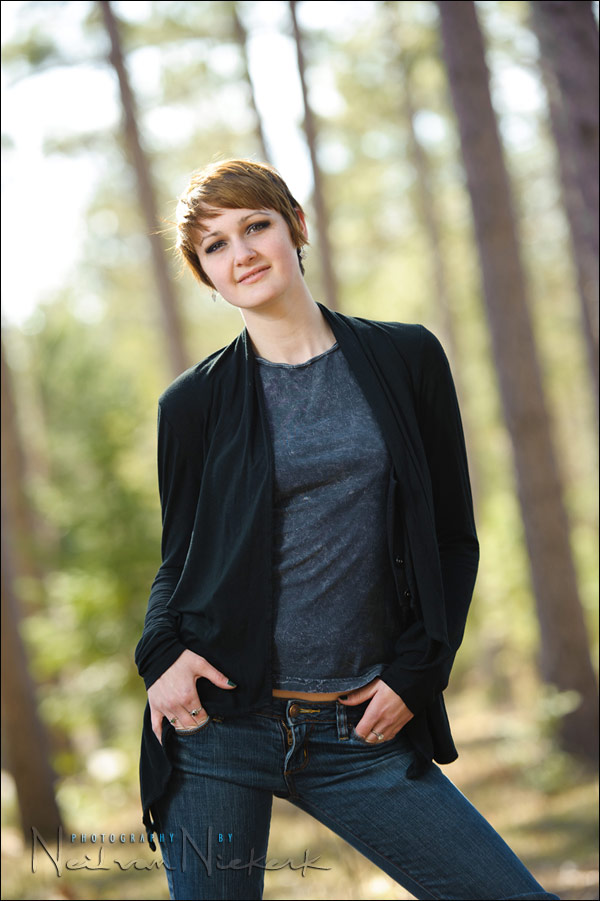
This image of Amy, one of our models at a workshop, is a fairly straight-forward portrait using off-camera flash in TTL mode. And it is ideal for an overview again of how easy the ambient & flash exposure metering is. The basic approach with this on-location portrait is to expose for the ambient light in the background, making sure our subject is somewhat under-exposed … and then to add off-camera flash with a softbox. The first question that came up was – how did I meter for the ambient light?
Metering for the ambient light
With this scenario, one has to grasp that there are broadly two main areas in the background that we could expose for. There is the brighter sky area, and then the less bright trees in the background. We can not expose for both of those ‘correctly’. You have to decide what your background is, and then decide how you want to expose for it.
I chose to expose for the trees in the background. This would then let our model be under-exposed to an extent … and then we bring up the exposure on her with off-camera flash. In choosing the trees as my background, I allow the brighter sky area to blow out. But in the composition of the image in the camera’s viewfinder, I made sure the blown-out sky area is a relatively small portion of the background. My main background area is the patch of out-of-focus trees.
This is an approach that I have emphasized over a number of articles on this site – you have to be specific in how you choose the background in the composition of your photos.
Exposure metering was simply done by looking through the viewfinder, eliminating the bright sky areas in the frame, and getting my settings in manual exposure mode. I purposely over-exposed a bit with this image, taking the exposure 2/3 of a stop up from the zero of my camera’s built-in meter. Why 2/3rds of a stop? Because I chose it that way.
In a sense, there is a no ‘correct’ exposure for the background in this specific scenario. You can choose to make it bright and airy with pastel tones … or under-expose and make it moodier and darker. Your choice.
So that’s how I metered for the background areas. I fix these settings in my camera by using manual exposure mode. Then my composition won’t affect my camera settings.
The next question that came up was – how did I meter for the flash?
Metering for TTL flash
The surprising answer was … I didn’t meter for the TTL flash. You can’t really. You have to rely on the technology. That’s the beauty of using TTL flash though – largely you can rely on the technology to get you there. The camera and flash will (via the pre-flash) figure out how much flash to add to the final exposure.
Then you can check on your camera’s preview whether you like the flash exposure, and then dial it down or up, via the flash exposure compensation (FEC) button.
That then is also the limitation of TTL flash exposure metering – you have to rely on the technology to give you results that you would like and need. And you can only really figure this out by checking the camera preview, and then adjusting the FEC to taste.
For a situation where you need to work fast, TTL flash is fantastically easy to use. But for a situation where you need numerous photographs consistently exposed, you will have a much slower post-production workflow than if you had shot with manual flash that you metered for.
Off-Camera Flash Photography
With this book, I wanted the material in the book to flow as a truly accessible introduction to off-camera flash. The techniques here are within the reach of everyone.
As always, the aim was for those aha! moments when things become clear and just makes sense. And then, hopefully, inspire the readers of the book to see how easily off-camera flash lighting can expand our photographic repertoire.
You can either purchase a copy via Amazon USA or Amazon UK. The book is available on the Apple iBook Store, and Amazon Kindle.
Manual flash vs TTL flash
With manual flash, you have to balance those 4 controls to give you correct flash exposure.
two of the controls are on the camera – ISO, aperture
two of the controls are via your flash – power, distance
So you’d use a lightmeter to calculate the manual flash exposure. Or perhaps you could use the histogram to determine correct manual flash exposure. Once you have your flash exposure fixed for that specific distance, and camera settings, then every exposure will be nailed. Constant. But if you change one of those four parameters (ISO, aperture, power, distance), then you have to juggle something else to get correct exposure again.
But where TTL flash shines in comparison, is in the flexibility in changing your settings. TTL flash will follow your settings, and give you (what it deems to be) correct exposure.
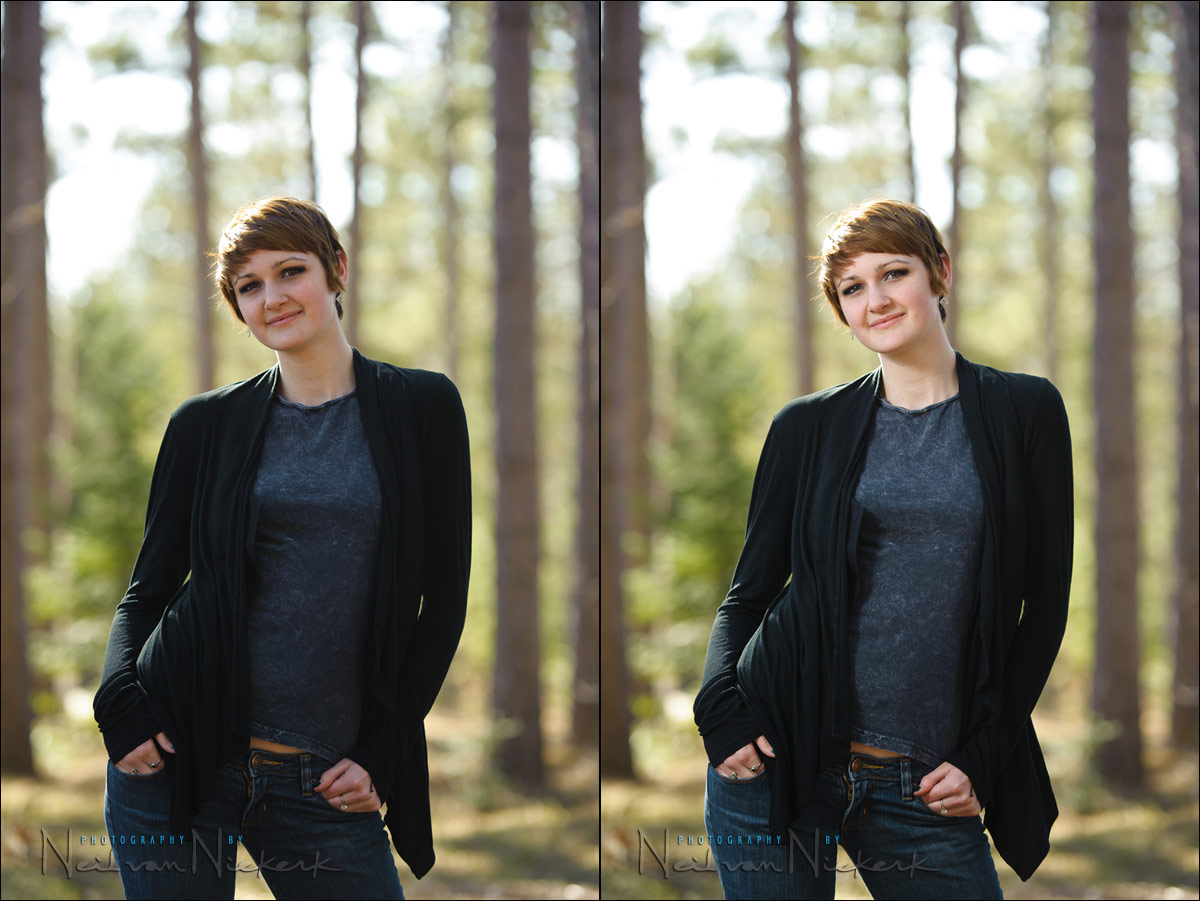
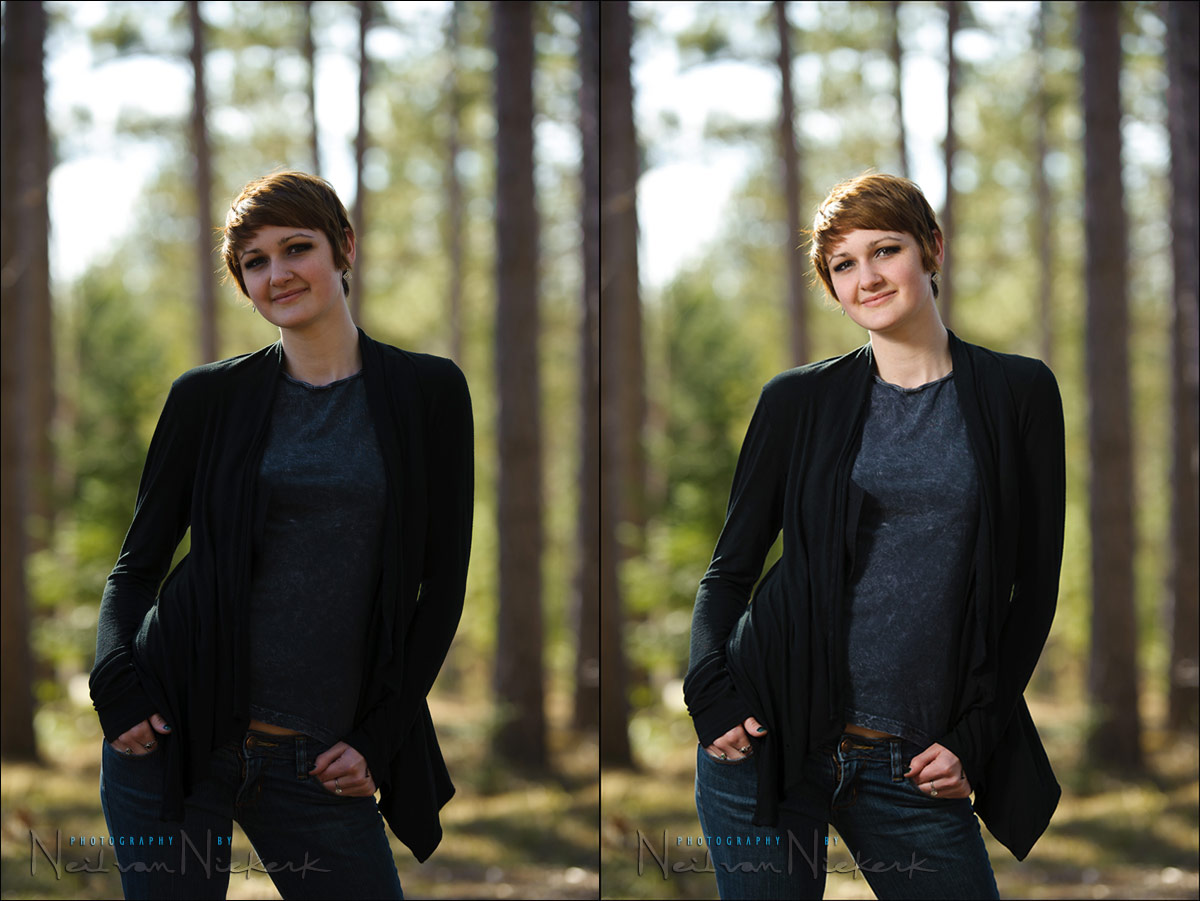
Here are two examples where I changed my settings between shots, also showing the ambient-only exposure. This shows how the TTL flash will just follow my settings, and give me correct flash exposure. Simplicity itself.
1st image group: 1/320 @ f2.8 @ 200 ISO
2nd image group: 1/500 @ f2.8 @ 200 ISO
Not a large jump in ambient exposure – just 2/3rd of a stop, but it still shows the TTL flash exposure picking up the slack and giving me correct overall exposure for our model.
Summary
With this article I wanted to emphasize again how easy it is to use off-camera flash, especially when TTL flash is used. There’s a certain latitude we have in choosing our settings (while keeping our subject under-exposed to an extent), and then relying on the TTL flash technology to give us correct flash exposure.
So now we have to be less concerned about specific settings, and can concentrate on other essential elements of the final photograph:
– directing our model,
– composition,
– direction and quality of light.
Photo gear used with this photo session
- Nikon D3
- Nikon 70-200mm f2.8 AF-S VR II / Canon EF 70-200mm f/2.8L IS II
- Nikon SB-910 Speedlight controlled by PocketWizard FlexTT5 Transceiver & AC3 Controller
or alternately, the Canon 600EX-RT Speedlite controlled by Canon ST-E3 Transmitter - Lastolite EZYBOX Softbox Kit (24″x24″)
Related articles
- On-camera TTL fill-flash
- Flash exposure compensation
- Tutorial: Balancing flash & ambient exposure (model: Anelisa)
- Various scenarios: Balancing flash with ambient light (model: Catherine)
- Best fill-flash settings (model: Scharmarie)
Excellent Post Neil….
Neil,
Thank you for a great example of off camera flash. Can you comment on where you placed the softbox to keep the shadow from this to a minimum?
Thanks again,
Bob
Hi Neil,
Very good article.. With one question.. When you use off-camera flash in a soft box, how could that flash able to meter, when that flash is block it’s sensor by the soft box.? I mean how can the pre flash signal goes to object and sense when soft box is large and blocked..
Lx
Thanks Neil!
Sony,
Neil is using PocketWizards which use radio frequency to transmit that information.
No line of sight needed.
Additionally, the Lastolite SoftBox that he is using here leaves the flash exposed. (it’s not in the softbox but on the outside of it, on a bracket)
Nikon’s CLS may have worked here as well without the use of PW’s.
Ciao Neil,
mi chiedevo se posso ottenere gli stessi risultati con un flash SB 800 puntato in avanti dritto? Con quale FEC ?
Pensavo di dover sottoesporre lo sfondo solo quando la luminosita’ e’ la stessa del soggetto……invece anche questa tecnica funziona molto bene..
Grazie sei un genio della fotografia.
Edy Trigona Genova Italy
Hi there Edy ..
You could get similar results with direct (bare) off-camera flash, but the light would be less soft. DIrect off-camera flash has a harder look to the light. I will have to post some examples soon as comparison. Direct off-camera flash can look really good, but a softbox is easier to use because a softbox is more forgiving about how you place the light. The softbox gives you more leeway in placement of the off-camera light.
There is another problem that can surface … you might be too close to your subject. Have a look at the distance scale on the back of your flash. That will tell you the range within which the flash can work. Just make sure you are within the distance that the flash can still control the light to give you correct output.
At the aperture and ISO used here – f2.8 @ 200 ISO my SB-900 tells me that my subject has to be within the 1.7 to 20 meter range. If I am closer than 1.7 meters to my subject with the bare (undiffused) flash, then I will get over-exposure from my flash.
Going to High-Speed Sync / Auto FP range like I did here, brings the minimum distance even closer, giving me more leeway here in how close I place my flash to my subject. Play with your camera settings, and you will see how your flash’s range changes with your change in settings. Also note how the flash range changes once you go over maximum flash sync speed.
Related links:
– maximum flash sync speed
– tutorial: high-speed flash sync
As to what FEC you’d choose. Check the link given there for flash exposure compensation.
You are correct in your summary that when the background and subject are equally well-lit, then you will have to under-expose your subject .. and hence under-expose your background … if you want to use flash like this. Generally though, it is easier if your subject is under-exposed compared to the background.
Neil,
I like how your writing style has evolved over the years. These recent blog entries are more detailed, more organized, and flow better than your writings from 2007. :-)
Good stuff!
TTL is amazing, even in areas of near total darkness. (Although I should be probably be using manual flash, but that is another lesson I need to delve into one day…)
I think Sony might be thinking that the flash itself (by virtue of its sensor facing the subject) takes part in flash exposure calculation. If softbox was blocking the sensor, or rather sensor was not facing where the flash light was going, how TTL flash exposure could/would work properly. (I do not know the answer.)
Hi Neil
i noticed that your shutter speed is over flash sync..and you are using flash at same time..was you in high sync speed?..and if this is the case then how did you manage with the drop power of the flash when you use this speed.thanks
Neil, Your post says you shot with a D3 and used a 1/500 sec shutter speed. The D3 has a flash sync speed of 1/250. I use a D90 which only syncs to 1/200 (maybe 1/250) in FP mode. I always have a difficult time shooting fill flash outdoors because at 1/200, my backgrounds become overexposed with the wide open apertures that I like to shoot at. How are you able to get your camera to sync at 1/500, and how do you deal with fill flash in bright situations with the lower sync speeds? Thank you for all your useful information over the years.
Hi Sony and Parv:
TTL is “through-the-lens”, and the exposure by the [low-power] pre-flash of the scene is calculated by the camera’s exposure meter. (The flash does not take part in calculating the exposure of the scene using TTL.)
best, sho
Was it simply TTL or TTL-BL? In situation like this, as you wrote in other Tangents, would be better to use TTL-BL because of strong backlight. Simply TTL could be afected by this light behind model. Maybe I’m wrong, please correct my way of thinking.
Anyway post is excellent as usually, best regards.
Neil, great explanation but most of all I just like the photos. Could I be so bold as to suggest that you have placed your flash deliberately to compliment the backlight so as to make the light look as natural as possible? It’s like a gentle addition to what already exists. You make me want to get out there now to see what I can do. John
Neil,
Comprei recentimente meu Ezybox. Tive que importar, aqui no Brasil não tem. Adorei usar pela primeira vez. Realmente é uma luz bem suave e de fácil montagem e de transportar.
Usei bastante ETLL -2,-1,0…
Recentimente postei no meu blog um post com fotos feita com ele.
Configurações:
5d Mark II, Ef Canon 85mm 1.8. Transmisor ST E2, Rádio Popper e um Ezybox.
Abraço
Neil,
I bought my Ezybox founded recently. I had to order it since no one in Brazil has it. I loved the first use. It really is a very soft light and easy to assemble and carry.
I used ETLL -2, -1.0 …
I recently posted on my blog some pictures made with it
Settings:
5d Mark II, Canon Ef 85mm 1.8. Transmitter ST-E2, Radio
Popper and a Ezybox.
Ricardo
Hi there Neil,
Congratulations on your blog. I’ve been a regular reader and I think you’re great for sharing your knowledge with us.
By the way, I’ve noticed you use a lot those PocketWizards. How do you compare them against Nikon’s CLS (I mean, using the wireless technology from Nijon’s speedlight)?
I’ve been using CLS for a while now and I guess it would just be redundant if I bought some of those to trigger my SBs wirelessly.
Cheers!
Hugo Carlone
Hugo … the wireless triggers like the new PocketWizards and RadioPoppers allow you the freedom to not worry about line of sight. So while Nikon’s CLS works fine, you do need to take care that you have line of sight, or else its behaviour can be erratic. The wireless triggers take care of that.
The majority of the images in my book, Off-Camera Flash, was taken using just Nikon’s CLS.
Great write-up thanks!
Good stuff, Neil. I find myself recommending your flash tips to beginners more often than the Strobist approach. After 30+ years of wrangling with manual flash, I can’t figure out why some folks insist on doing things the hard way when Nikon’s TTL flash is often much more efficient for candid photography and portraits outside a controlled studio environment.
Hi there Neil,
I have been following your wonderful teachings on your site and it has really improved my flash photography works. Thanks so much for sharing. I’m a devoted follower of yours for more than a year now since I started going into the not so complex world of flash photography (thanks to your clear and easy to follow tips), you make it look so easy to do.
I wish i could post a photo of a recent shoot i did.
Hi Neil,
What impact does the focus point play in off camera TTL. Specifically, what if I am using the centre focus point of my D700 then recomposing? Doesn’t the TTL measurement of light returning from the preflash have some correlation to the placement of the focus point?
Lets assume that in the picture above I was to focus on the eye then recompose so that the focus point is now on the background (half press of the shutter of course). Is the camera still assuming that my main subject is in fact the eye/face and not the background?
Hope that makes some sense!!!
Hi Neil,
Thank you for all your knowledge sharing it has helped me and others like me immensely.
My question is how can you acheive TTl off camera do you have to have a wire from the camera?
Will for instance say a Nikon D700 be able to control the flash off camera with the onboard flash or should you buy radio triggers and if so which RT’S send info to the off camera flash? I always thought that TTL was measured from the point of the camera as in thru the lens. So your flash output has a fixed constant to make it’s calculation from.
If your making a shot at say 105mm and your twenty feet away, but your flash is held by assist about five feet away out of shot do you then have to shoot and chimp if so thats not TTL to me.
You are probably getting a sense of how easily i can confuse myself by now, can you point me in the right direction please
best wishes Jamie
many Thanks
Neil – When using off-camera TTL flash you have stated that you will check the preview as to whether you like the exposure on the subject. When you are looking at the preview are you paying much attention to the histogram (assuming there is no white) or are you just looking at the subject on the preview. It has proven difficult for me to evaluate subject well depending on light conditions on location.
Hello Neil your articles are very helpful to me. I use nikon D700 and do shoot in a group of canon guys on weddings. Problem is my images looks less better than them. And shooting in TTL mode my SB900 would not last but heat up. I need help should I switch?
Hi Neil,
Always enjoy your articles and have been following it since I read your book,Off Camera Flash.What do you do when you try to meter ambient light that is low resulting in shutter speed that is too slow to handheld and using tripod is not flexible for an outdoor shoot?How do you compensate?I guess the question also applies when you try to “drag” the shutter speed.
Hi Neil,
Just bought both your books and cant wait form them to get to New Zealand.
I have a question and hopefully it doesnt sound to silly. When I meter for the ambient light and then swith my pocket wizards on it only allows me a shutter speed of 250. Which I understand. I see in your example that you shoot in of camera with the wizards at 320etc. I dont seem to get this right or do i just switch them off set the camera in the M mode to a higher shutter speed and then take the shot ?
thanks for all the help …
Groete van New Zealand
gerrie
Hi Neil
I love your guides. I read both of your books and online blogs and you always seem to use a large 24×24 soft box. My question is whether it is worth using a smaller softbox or just using direct flash when there is no where to bounce the flash outdoors. I know your point is to have a light source that is large so it produces a diffuse look but wanted to know your thoughts on this.
Thanks.
Lance
Thank you for the great article. I am just getting into using off camera flash and it was very helpful.