Wedding photography: Using high ISO and flash at the reception
Chatting with other photographers at the recent WPS convention in Chapel Hill, NC, I was again struck by how there are so many different ways of approaching lighting. In this case, lighting at the wedding reception. The one photographer I was chatting to, set up multiple speedlights around the reception room, and then controls which are fired, from his on-camera Master speedlight. Very impressive.
In recent years, the wedding reception venues where I’ve shot on the East Coast of the USA, have moved away from being the dark-hole large rooms, by adding up-lighting, and making the places generally more vibrant and colorful. Coupled with the astonishing high-ISO capability of the last two generations of cameras, I really haven’t felt the need to set up additional lighting to lift the general light levels, like I would have in the past, as described in this article:
– wedding photography: TTL flash with off-camera manual flash
Here is a recent wedding at the same venue as the above link … where I was able to effectively light the entire place with just one on-camera speed light.
– bounce flash photography & the inverse square law
By using a higher ISO, and carefully bouncing my flash, I could get away with a much simpler set-up of a single on-camera speedlight.
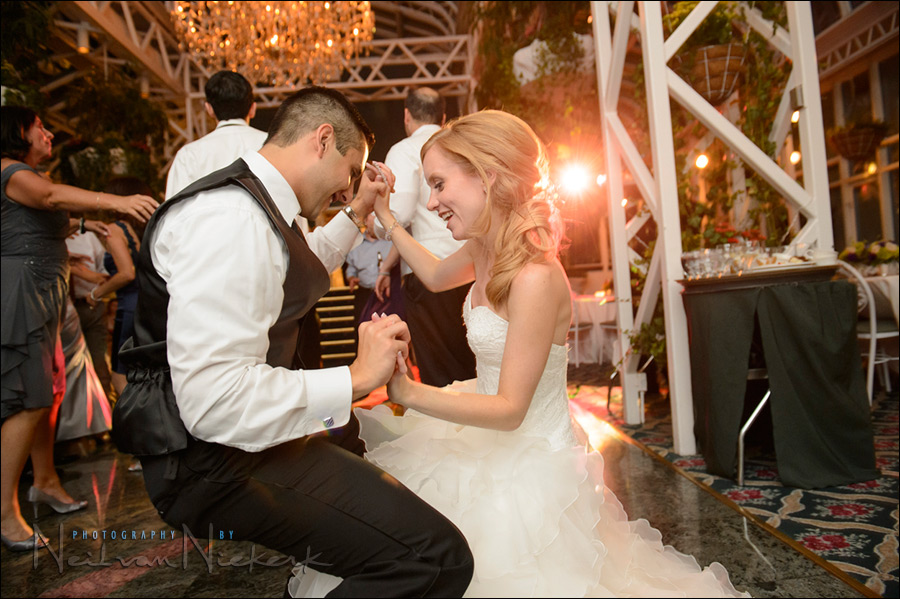
Here’s an example of a recent wedding, where the reception was in a glass-house style conservatory. By shooting against the DJ’s lights, I was able to NOT have a dark background, but something colorful instead.
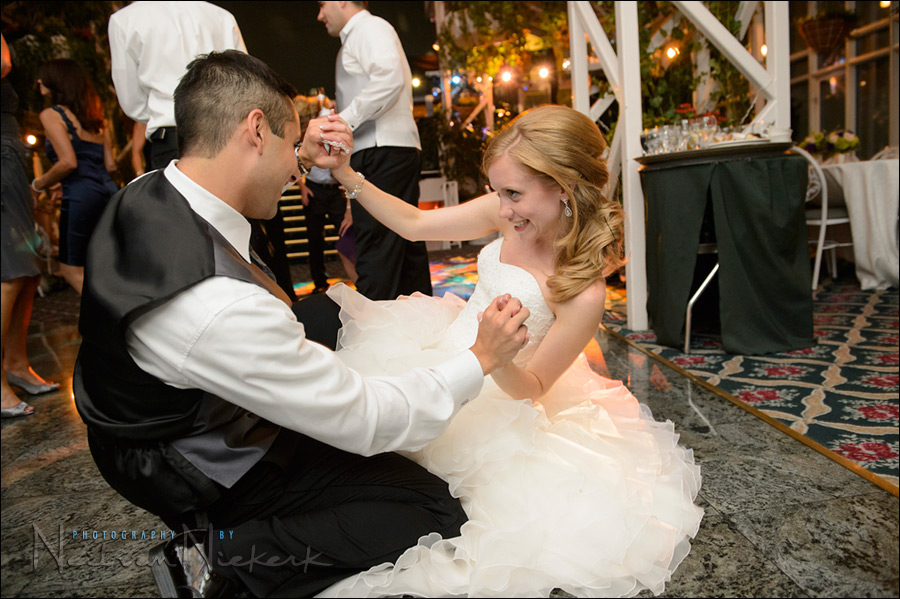
Camera settings & photo gear used
- 1/60 @ f3.2 @ 2500 ISO
- on-camera TTL bounce flash, gelled with 1/2 CTS gel
This is a simple technique that I constantly use when photographing the wedding reception – I look for brighter areas in the background, and *I* move around so that I can place my subjects against that. The colors and shapes in the background helps place my subjects in context of the wedding … as opposed to a dark background that they blend into.
It means I do move around and look at my backgrounds specifically.
Now, about the area where I bounced my flash … a glass house with white structures. For the two photos above, I was bouncing my flash off the entire area that you see there in the center of the image …
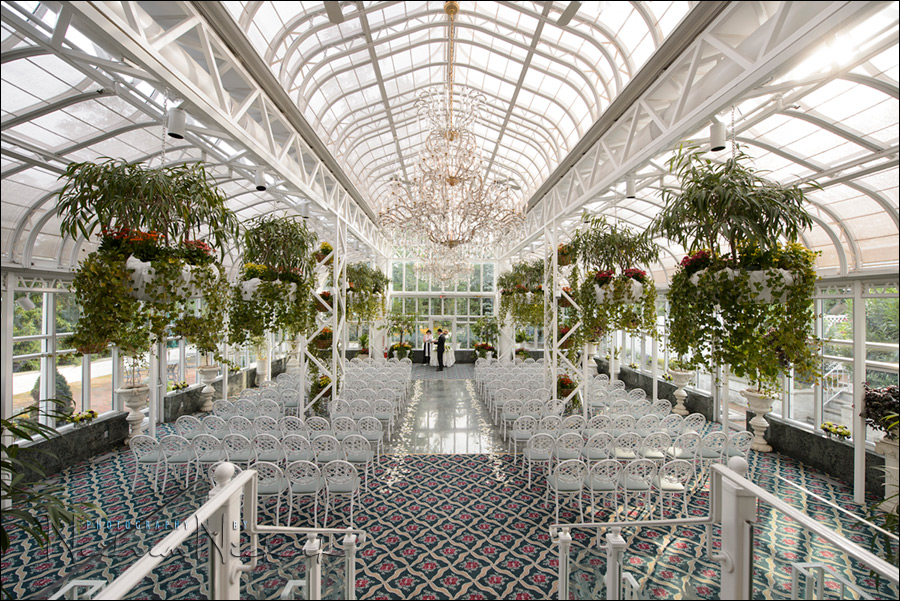
… looking towards this direction.
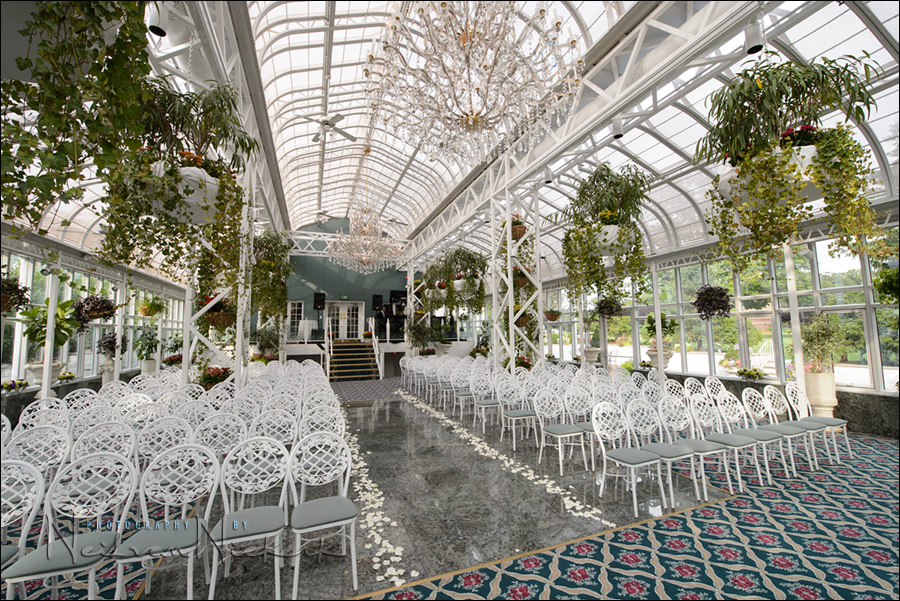
At first it doesn’t seem realistic to get enough light from a single on-camera speedlight there just by bouncing it behind me … but with a high enough ISO, it is quite feasible, and actually looks very good. Then it becomes a matter of finding the right aperture and shutter speed (along with that high ISO), to allow enough ambient light in to give context and a sense of mood.
Related articles
- Bounce flash photography & the inverse square law
- High-ISO bounce flash with on-camera speedlight
- Wedding reception lighting with one flash
- Bounce flash examples – wedding receptions
- Bounce flash photography tips
- Wedding photography tutorials
- Ashley & Michael – wedding – Madison Hotel, NJ
Neil
Thanks for this article.What would be your White balance for this scenario now that you are using half cut CTO.
thanks.
-MP
muito linda a foto coloca do casamento nesse mesmo lugar . uma pergunta desculpe , a 24x70mm que o sr usa serve pra dx ?.
Dude. I spend a lot of time writing these articles. The least you can do is meet me halfway on this and use Google Translate before you post. Don’t make *me* work even harder here.
I suspect that Neil set his camera’s white balance to approximately 3700K using the 1/2 CTS, not CTO.
I like how shooting this way keeps things simple!
I don’t think my D700 pictures could look that good at ISO 2500. The D3/D4 models really do outstanding work at high ISOs.
I just discovered this site a few days ago and have been trying to absorb all the information. Your website is by far the best website on lighting technique! Thank you for writing and sharing your knowledge.
Quick question, when taking pictures at the reception, do you set the camera on manual and auto ISO? Or do you manually set the aperture, shutter speed, and ISO?
Manual everything on the camera, and in this case, TTL flash.
Using Auto ISO would mean that ambient light exposure isn’t exactly how I decided it to be. I prefer my ambient light exposure to be fixed / determined … and then I can add flash to the mix.
Hi Neil, I have bought and read your two books. I have followed this website for a year.
One thing that I don’t understand, how you could shoot wedding with manual everything on the camera and using on camera bounce flash.
How come you don’t miss a moment if you have to adjust the flash head and manual exposure for every pic that you are going to take?
Could you please enlighten me. Thankyou verymuch.
I have an sb700 that is not strong enough to light up an entire hall on bounce, no matter what ISO. The other day I borrowed an sb900. On full power, which what it takes to light up the hall, the flash overheats constantly. How do overcome this problem?
Chaim,
A lot of people, including Neil and myself, merely go into the SB900 menu and turn off both the audible and the sensor indicator on overheating:
Caveat: Turning off warning indicators does not mean the flash will not overheat, it will merely prevent it from turning itself off after a ridiculously short period, you need to keep an eye on the flash thermometer indicator to see if its risen up high. But generally you won’t be multiple blasting for a long period of time. Still, Neil has fried the freznels on flash heads a few times. :)
Now, there are a couple of things you can do to also help.
1] Batteries. If you use a high capacity normal batteries [non-rechargeable] that will cause overheating. But also if using rechargeable, feel the battery when charging, since if it feels hot and it get hot discharging. Most of us use Sanyo Eneloops rechargeable helps.
2] Having an external battery pack like the Nikon SD-9 battery pack will help dissipate the heat.
https://neilvn.com/forum/discussion/166/nikon-sb900-overheating
I just found your site and I’ve been pouring through these articles trying to figure out what I’m doing wrong… I would really appreciate a response, as I don’t know who else to ask!
Lately I’ve found that almost all my indoor flash (wedding reception) images are soft. Too soft to use. I don’t have a ton of equipment yet, so I rely pretty heavily on my 24-105L IS f/4. Because it’s an f/4, I wind up cranking up my ISO. (shooting w/ 5D mark I, so I *do* get noticeable grain). My settings generally look the same, I guess, probably at f/4, ISO 1000, and a shutter speed between 80 and 125, shooting with the flash in ETTL (580EX II). I know the image stablizer won’t help to freeze motion, but I thought that the flash combined with my shutter speed would. Instead, images with any motion are blurred and soft. Even some of the shots without motion are really soft. I typically bounce the flash up with a card because I feel like I need to get as much out of it as I can with my f/4 lens, but sometimes I throw the light up and to the side, too..
Do you think this would be a problem with camera shake?… that my equipment just isn’t right for the low light conditions?… should I bounce the flash differently and/or change up my camera settings/ISO?
The last reception I shot was in a hall with window light, but I still had the same issue. Could it have been the ambient light interfering in that case?
Any thoughts at all would be greatly appreciated, as I’m starting to despair.
Mandy
Mandy … it really depends on a few things.
Most importantly, the balance between flash & ambient, and specifically how much your ambient light is under-exposed. If there is a lot of subject movement, and your ambient light levels is close to the flash exposure, then you have a higher chance of blur.
Subject moment and camera blur appears differently in the photograph. Can you distinguish which is plaguing you?
We’d need to see examples to really figure this one out. Feel free to post in the Tangents forum where you can upload images.
Also .. it could be that your camera and lens needs calibration and that it is a focusing error?
Neil,
Wow, thank you for the quick response! I will try to change up my settings so that the flash is compensating more – that might be part of it. I have a wedding tomorrow, so I’ll just have to focus on trying several different approaches to see if I can nail down the issue. I will go back through the images and check out the forum.
Thank you!!
Mandy
I borrowed an sb900. On full power, which what it takes to light up the hall, the flash overheats constantly. How do overcome this problem?
The Nikon SB-900 thermal cut-out can be disabled.
If you shoot fast, then over-heating is a problem for most speedlights.
InvitesWedding,
Read above Post # 11
You cannot stop it warning and shutting down under just normal circumstances I am afraid, but you can turn it off.
Read the ‘Caveat’ I put in that post though. :) Read the last link, this ‘could’ happen, up to you. But I have my now turned off for quite a while and I let it just go, with no trouble so far.
Trev
Great article, Neil – thanks. I use a combination of setting speedlights set up around the room controlled from the camera (and a video light) combined with high iso (on a D800). This works very well as we invariably cannot bounce flash here in the far north of Scotland, where venues are painted in interesting colours such as burgundy red, vivid mustard yellow, navy blue and/or a combination of all of these…. and often with an orange-stained wooden floor. Venue lighting is usually shut off so it is as dark as a 1980s school disco ;-). An article on removing such terrifying colour casts would nice :-))
Bounce flash photography and white balance settings.
Thanks to you and your Tangent blog and your books I have been reading two times I was able to make pictures in a dark situation, with most black walls. Just on camera ttl flash with black foamie thing. See 25-8 http://www.roodbootje.nl/week%2034-2012.html
Neil, I was just wanting to know if you set up stands and use flash and reflector in different positions around subject. Putting flash in front of reflector and bouncing light that way. Was also wondering from a previous post I saw from you how do you position your soft box in outdoor use to archive the short and broad lighting look. I have tried but can’t seem to get the needed effect that I want. If you could give me a rough guide line that would be appreciated. Thanks.
In this case, I didn’t use additional lights.
Re: broad and short lighting.
I live and work in Cyprus so a lot of receptions are open-air (outdoors) with nowhere to reflect/bounce – what do you recommend I use a speedlight modifier?
Great website btw – love reading your posts/tips
Alexis
I was lucky enough to shoot a wedding reception with NO FLASH what so ever. I wasn’t being paid, so it was a perfect time to experiment with the hi ISO of the D800. I set the ISO limit to 2500 and shot with the fastest glass I had – 50mm, f/1.8, 1/60 sec.
I metered off the bride’s dress and took it from there. For the most part I was extremely happy with the results. Some were out of focus, but I was expecting that because sometimes I couldn’t even see what I was focusing on. The bride and groom loved the photos and I loved the ambience and colors they portrayed.
Sure, the originals may be a bit noisey, but those are 24 x 16, and who get prints that large? The 4×6 and 5×7 images look crystal clear.
Here’s the link: http://stevezimmer.smugmug.com
Since you used such a high ISO, how did your photos manage to not show any noise?
Well, the biggest reason you can’t see any noise here, is that a 16 megapixel image was scaled down to an image size appropriate for the web. That usually hides most indication that there is noise.
Then, I also expose correctly. I don’t often have to push the exposure up in post-processing the RAW file. That helps considerably.
And then … I used the Nikon D4 here. Modern DLSRs have incredible high-ISO performance.
Neil, I really appreciate all the information on your blog, I’ve learned so much! I was curious, in the examples above did you have a diffuser of any kind on the on-camera flash?
No diffuser, just the black foamie thing.
In response to comment number 12 – take your camera off aperture priority perhaps?!? Great articles btw Neil, very informative :)
Now it all makes sense. Thanks Neil.
Great post! Just a little confused on how you said you bounced off that green “wall” on those first two images. How is that possible when the wall was behind the couple dancing in front of your lens? You can see the stairs right behind them leading up to the wall.
Thanks!
I corrected my text now – I see that it was ambiguous. Sorry for the confusion.
The green wall you see in the 2nd photograph is the direction I was shooting towards. It is behind the couple in the two photographs shown at the top.
I was bouncing my flash into the large observatory behind me, as shown in the first “pull-back” shot of the entire venue. What I meant with “wall” there is that people assume you have to bounce flash off a specific area like a wall, and there I wanted to show there isn’t a wall as such – just the entire venue behind me.
Yes indeed, you can bounce of glass! Just not always 100% depending on the angle.
Hi, Neil thanks for the info and tips, just one question, at weddings when your on the go with your flash in TTL, what mode do you have your camera in, do you put it in Manual or Aperature priority and use exposure compensation. Many thanks
My camera is always in manual exposure mode.
What a great article. I don’t quite have the funds to step up to the full frame for better ISO, so in the meantime, I have a little more knowledge on how to keep some of those grain issues at bay.