wedding photography – best lenses
With this recent review of the Nikon 24mm f1.4 the question came up about which lenses I use when photographing a wedding, and how I use them.
How do you juggle the various lenses you have for weddings and decide which ones to bring to a wedding and when to use them? Do you carry them all and just use them when you feel, or do only take specific lenses knowing what the wedding/venue will be like and know in advance that you will certain lenses at various times during the day?
Choosing which lens to use while photographing a wedding, is obviously an extension of your own style. It affects how you want to portray your subject, or the scene, through choice of depth-of-field, perspective and angle of view … or even through some special effect, such as a fish-eye lens or tilt-shift lens.
While the specific lens you use for any shot might be motivated by stylistic choice, there are also practical matters that come into play. Sometimes the lens I choose will simply be the one already on my camera.
I also like having a wide arsenal of lenses available to me to use. There is a reassurance in this idea, that I have the best and fastest that is available. I want any limitations that exist, to be my own as a photographer, not because of my equipment.
So here’s how I juggle lenses and cameras …
I want to keep the discussion of lens choice away from a specific system for now, and will then later on go over the specific lenses I either use or would recommend for both Canon and Nikon.
I use three full-frame camera bodies. My two workhorse lens with which I photograph 90% of the wedding day, are the 24-70mm f2.8 and the 70-200mm f2.8 … the third body is the one I use to rotate any other lenses on. I have the 24-70 f2.8 and 70-200mm f2.8 zooms nearly permanently assigned to a specific camera. Not changing lenses on those two primary bodies mean that I significantly reduce the chances of dust on my camera sensor.
My main two bodies both have a speedlight on them, along with a battery pack attached to the strap. The third body doesn’t have a flash.
On the third body, I rotate a variety of lenses:
– fish-eye
– ultra-wide zoom
– macro lens: 100mm / 105mm f2.8 macro
– fast medium portrait lens: 85mm f1.4 / f1.2
I carry these (or a selection of these) in a Crumpler 7 Million Dollar shoulder bag (B&H), with me where needed. I discarded the partitions, and just have it as a big hollow flexible shoulder bag. I keep everything in Tamrac Big Wheels rolling strongbox (B&H), and work out of it, or keep it in my car … or chained to a table in the reception room, using a bicycle lock. But during the bride’s prep and the ceremony, I will have the smaller selection of lenses and third camera body with me in the Crumpler bag.
I have, but rarely use the 50mm f1.4 prime lens.
It just doesn’t seem wide enough, nor tight enough.
I’d like to use the same wedding of Kristy and Tom that I showed with this recent post, to illustrate where I’d use these lenses, and the results I get:
24-70mm f2.8
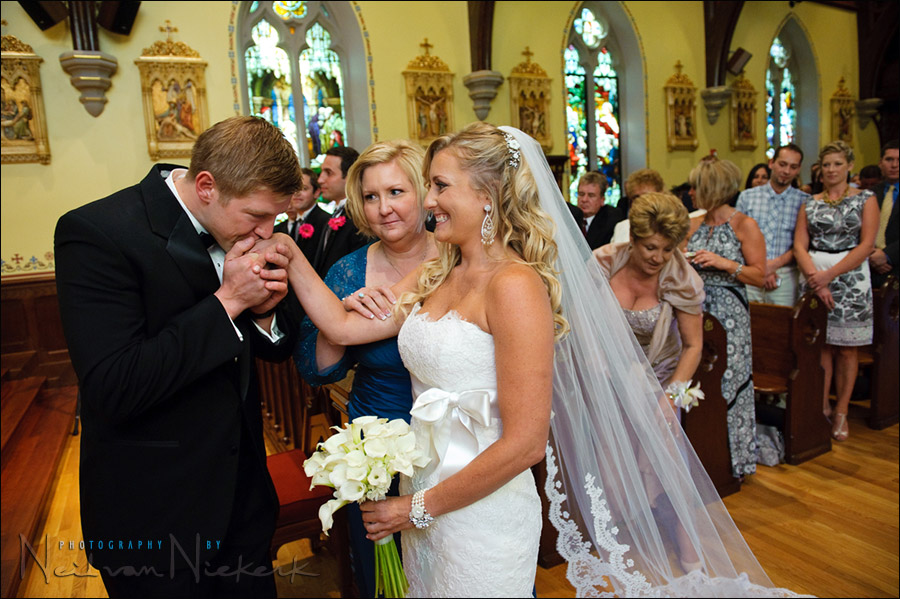
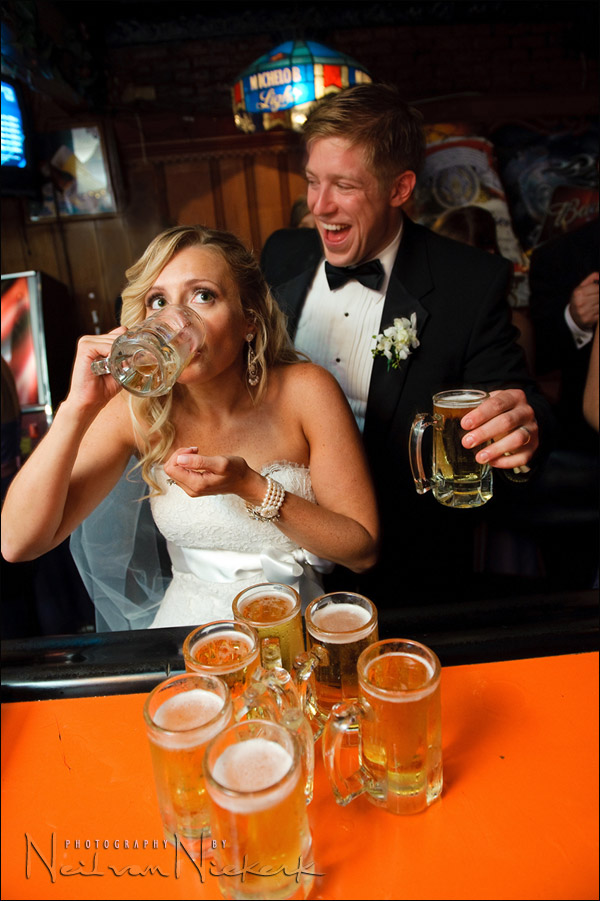
As much as I love using my 70-200mm f2.8 zoom, the 24-70mm is really my bread-and-butter lens. It is the one lens without which I can’t even imagine photographing a wedding. From bride’s prep to the ceremony to the formal and romantic portraits, all the way to the reception, I have this lens on the one camera on my shoulder at all times. It is the lens I would instantly reach for if anything came up unexpectedly.

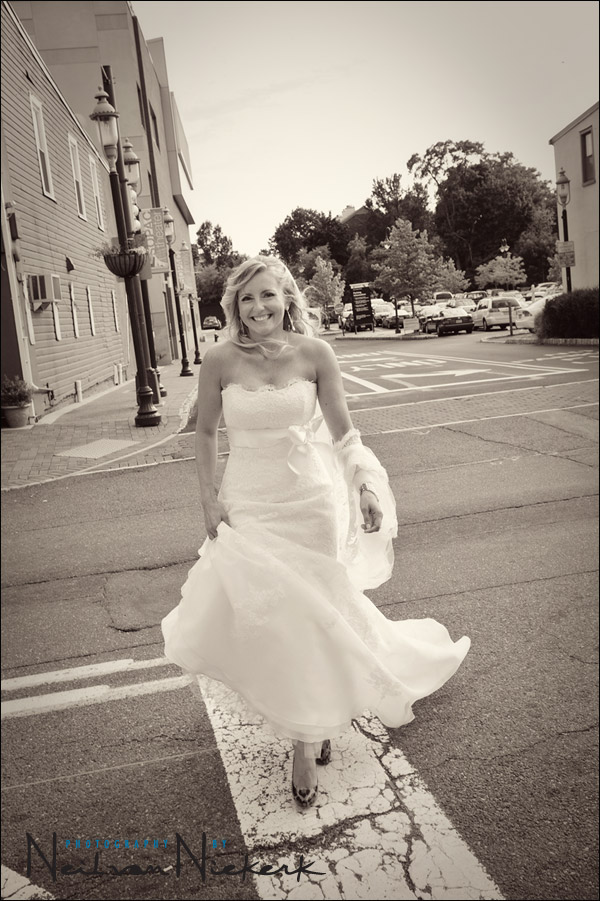
70-200mm f2.8
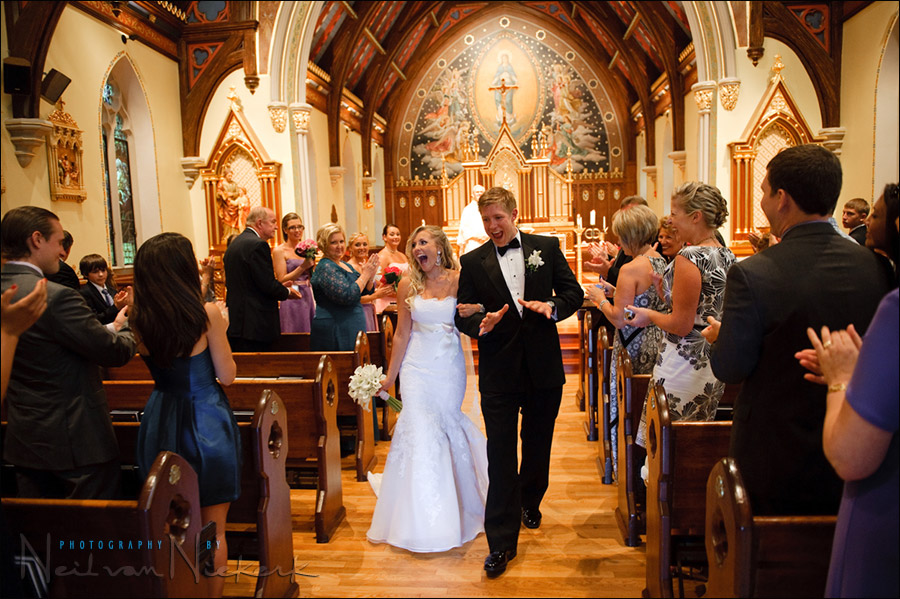
I do believe the 70-200mm f2.8 really only makes sense on a full-frame camera body. Then it becomes an ideal portrait range. On a cropped sensor camera, it is a little too tight. The 70-200 then is the lens I use for portraits, and for use during the church ceremony.
It is also the lens I use during any of the formal dances. I’m most definitely not going to step on the dance-floor and tap the bride and her dad on the shoulder to smile for the camera, like traditional wedding photographers might. The distance that the 70-200 allows me, lends itself to being more of an observer during the wedding.
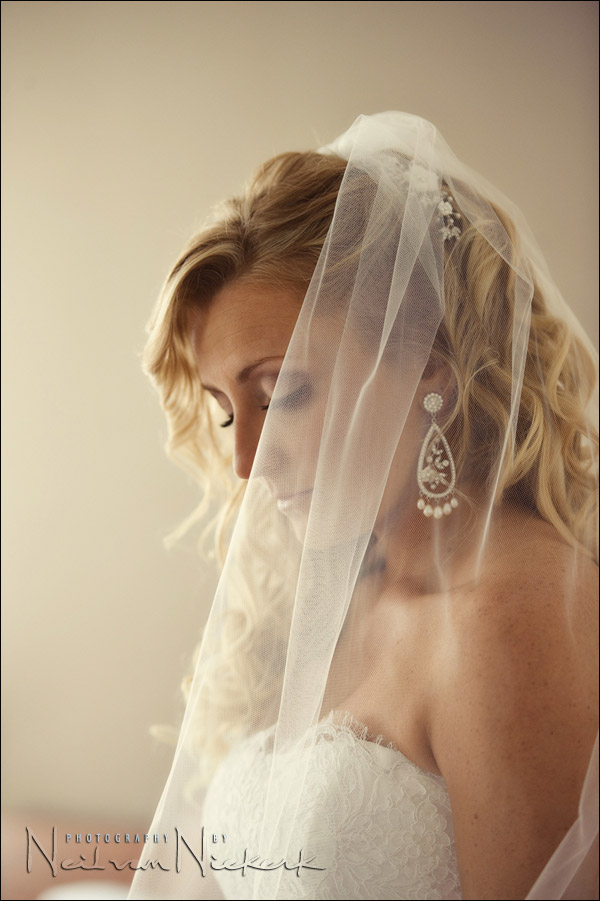
The photo at the top of this article was shot with the 70-200mm f2.8 at maximum aperture, using the available light in the room.
The 70-200 has to have image stabilization / vibration reduction.
This is essential in low light, as is the f2.8 maximum aperture.
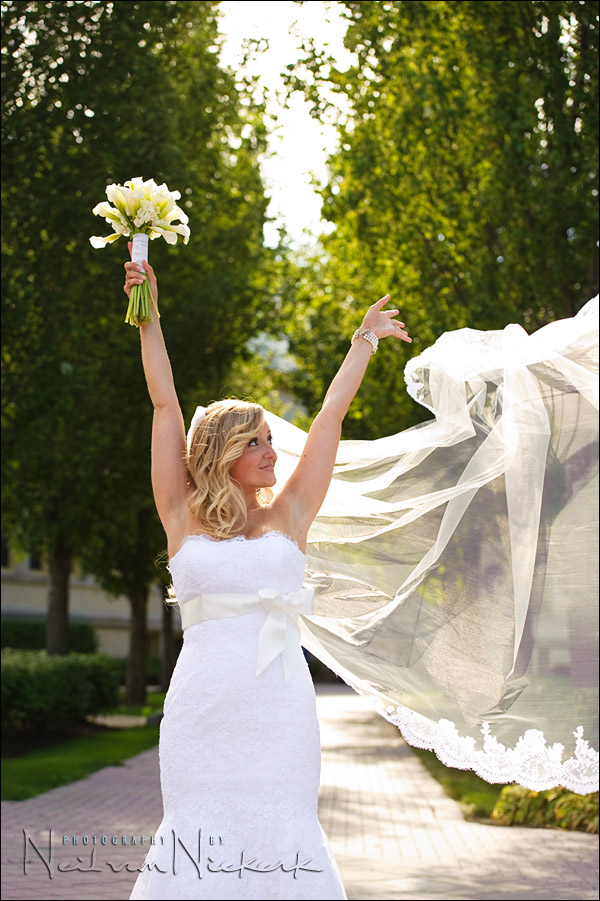
When working outdoors where I have the space, I ever prefer using the 70-200 for the formal portraits and family photos. I really like the compressed perspective that the longer focal length allows.
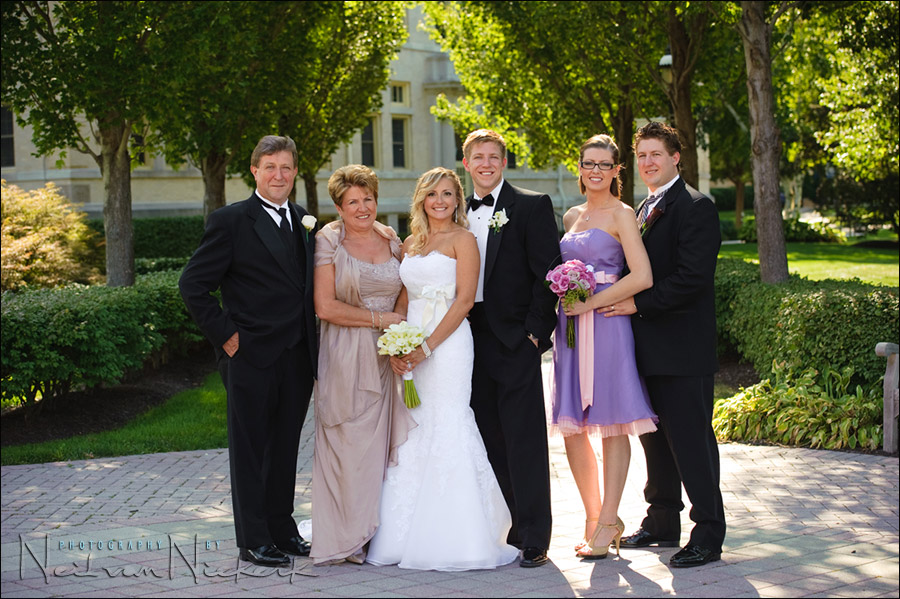
ultra-wide f2.8 zoom
I really like using this lens for scene-setters such as an all-encompassing view of the church interior and the reception room interior. The dramatic perspective also makes for interesting romantic portraits.

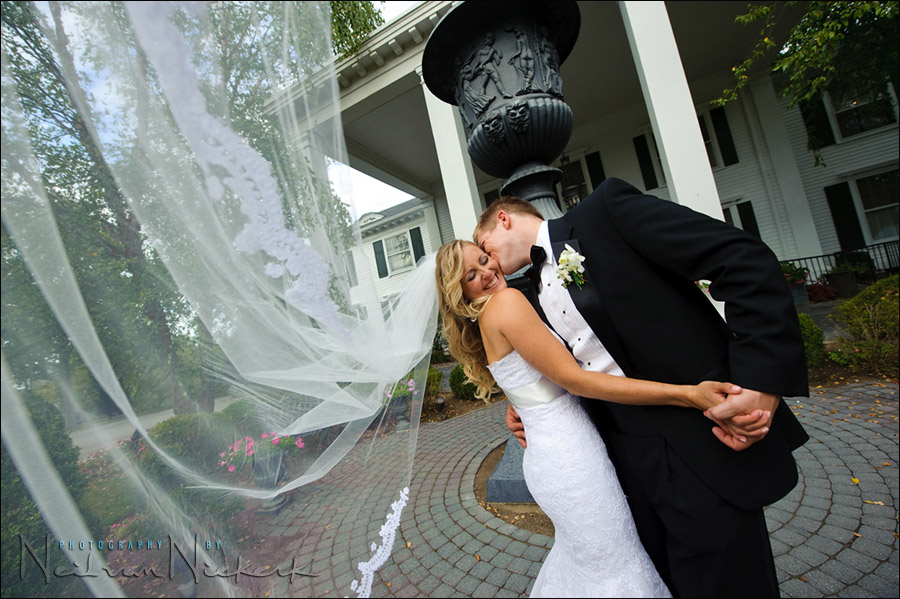
wedding photographer – Park Savoy, NJ
The venue here is the Park Savoy in Florham Park, NJ. For a wedding photographer it’s a great venue, offering a number of photogenic spots.
fish-eye lens
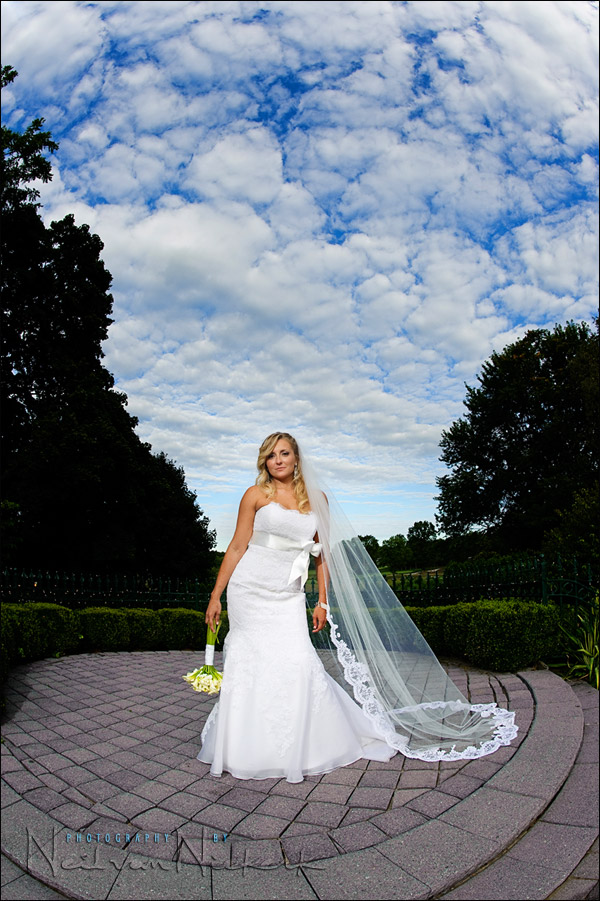
In my opinion this is a specialty lens, bordering on being gimmicky when over-used. But it can be effective. Here is a full-frame shot of the bride, using a fish-eye lens. (I used wireless TTL flash here to bring the exposure for the bride and the sky more in line with each other. The slaved speedlight was held up high by my second photographer standing to my left. It was used as direct off-camera flash.)
100mm / 105mm macro lens
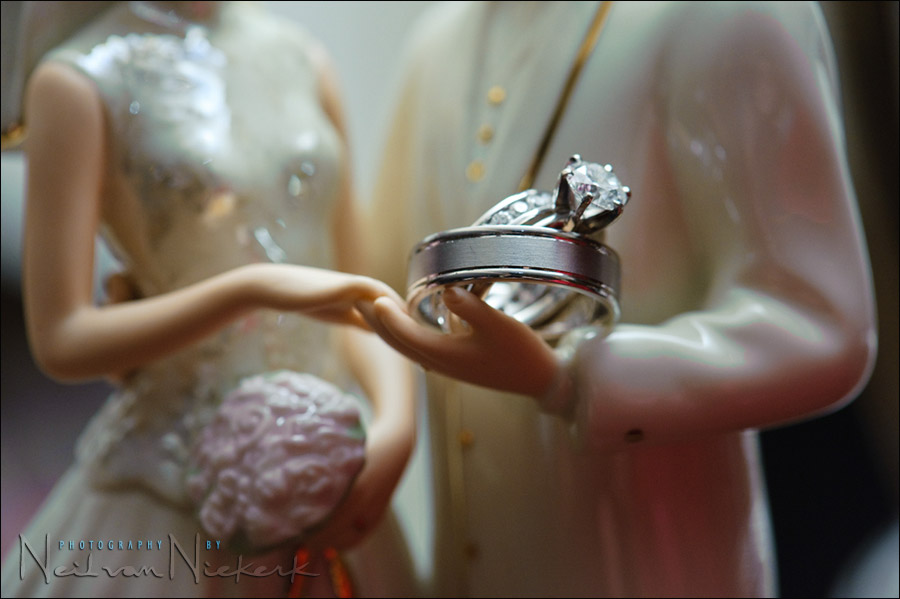
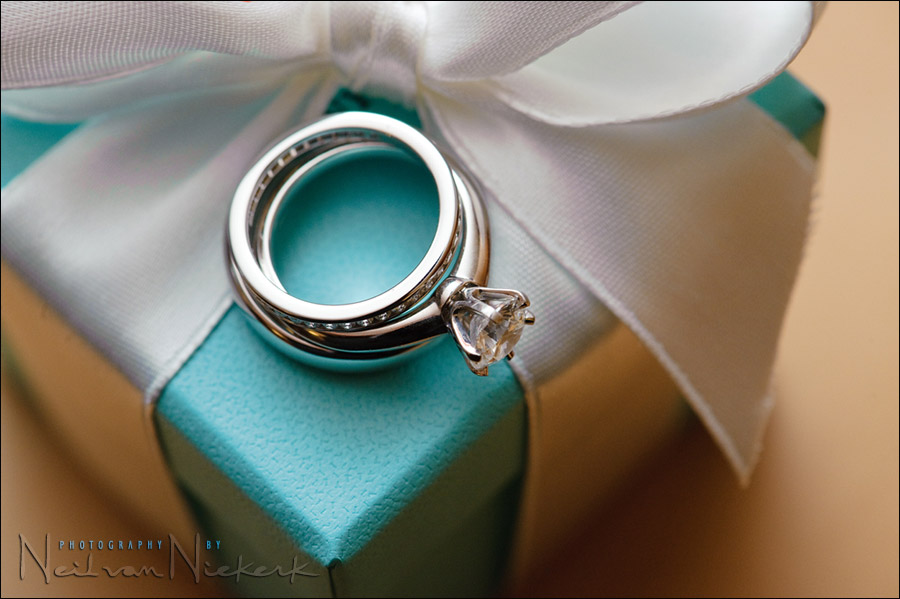
This lens is essential for close-up details. Here is a shot of the couple’s rings, using the cake topper. The image below of the rings on the ring box, is from another wedding, just to show the use of the macro lens.
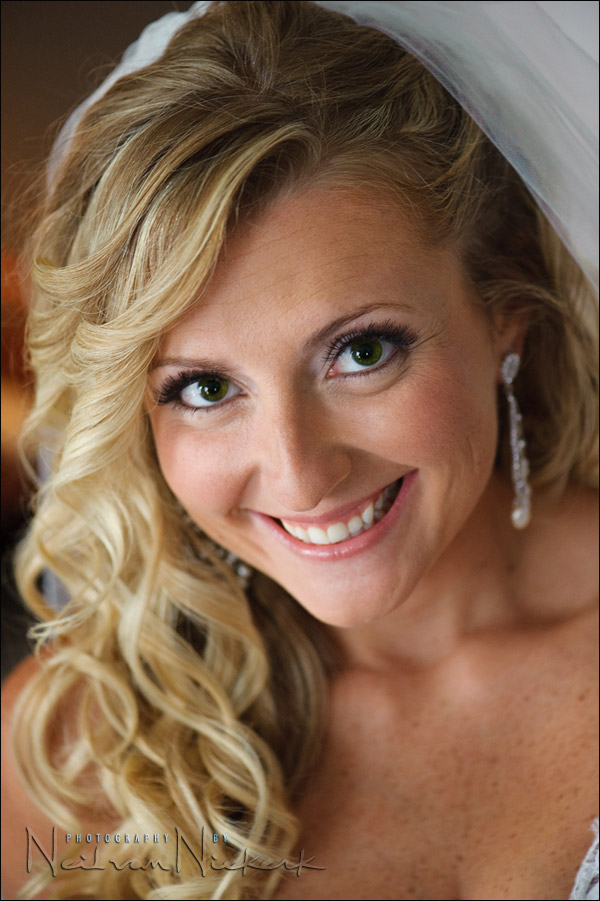
I also photograph the bride’s details such as her jewelry and hair-pieces and such. And then the lens is often just handy for a close-up portrait. This is why I favor the 100mm / 105mm range for the macro. The 50mm lens would be too wide on a full-frame camera to use effectively as a tight portrait lens.
This portrait of Kristy was with available light only. It is typically a photo I would do with the 85mm f1.4 / f1.2 at close to max aperture for that distinctive shallow depth of field of the 85mm lens. But this day I had the 105mm macro handy. It works too.
There it is in a nutshell. I rely heavily on two top-notch fast zooms, that I carry with me – each on a camera body with a speedlight. Then I mix it up with a variety of lenses for a few shots, using a third camera body. It’s a lot of weight to carry, but I try not to carry everything simultaneously. I’ll put the bag down, and perhaps one of the main cameras, when I can. However, the security of the equipment is a huge concern. It also remains a constant balancing between the need for flexibility and moving fast … yet having the right equipment on hand.
related articles
recommended lenses for Canon
Tamron 17-35mm f/2.8-f4 Di LD
Canon EF 24-105mm f/4L IS USM
Canon EF 70-200mm f/2.8L IS USM — (my review of this lens)
Canon EF 15mm f/2.8 fisheye
Canon EF 24mm f/1.4L II USM
Canon EF 35mm f/1.4L USM
Canon EF 50mm f/1.2L USM
Canon EF 85mm f/1.2L II USM
Canon EF 100mm f/2.8L macro IS USM — (my review of this lens)
for the 1.6x crop-sensor Canon DSLRs, I would recommend:
Canon EF-S 17-55mm f/2.8 macro IS USM
recommended lenses for Nikon
Nikon 14-24mm f/2.8G ED AF-S
Nikon 24-70mm f/2.8G ED AF-S
Nikon 70-200mm f/2.8G ED AF-S VR II
Nikon 16mm f/2.8 AF fisheye
Nikon 24mm f/1.4G AF-S — (my review of this lens)
Nikon 50mm f/1.4G AF-S
Nikon 85mm f/1.4G AF-S — (my review of this lens)
Nikon 105mm f/2.8G AF-S VR macro
for the crop-sensor Nikon DSLRs, I would recommend:
Nikon 17-55mm f/2.8G AF-S DX
Nikon 35mm f/1.8G AF-S DX
Nikon 10.5mm f/2.8G DX fisheye
Neil, thank you for sharing this.
i always check every link you give in your article.
i would like to know, is the 70-200 “breath” annoys wedding photographer?
do you feel it annoying in the wedding day pratically?
thank you
Hi, Neil
Today, Nikon has introduced AF-S 24-120mm F4.0 VR also. This is one of lenses I have been waiting for, and so have lots of wedding photographers around the world, I guess. Although I’m a Canon shooter and have to stick with it for now, I am willing to have some Nikon gears eventually. I would love to know what you have to say about the lens, compared with Canon EF 24-105mm F4.0 and am looking forward to it.
Shig
When I saw this post I just went wow, can’t believe a question I asked ended up as a full article!!!
It was nice to read that I’m doing something similar to you Neil, I have two camera bodies, D3 and D700, I put the 24-70mm on the D3 and it never comes off, dust is the main reason for this. The 70-200, 14-24 and 85mm then swap around on the D700, as it has a dust vibration system I don’t worry about it that much.
John
Hi, Neil
Suuuuper interesting post!! Thanks!
What would you do if one of the bodies breaks down? Hopfully not! But what if…
That is a lot of stuff to carry around. I can’t see how you would carry two bodies with flashes and that Crumpler bag, and maintain any kind of mobility. Do you have someone who just carries some stuff and hands you what you need?
Niel,
Do you not recommend the Canon 24-70 2.8 L? I’ve seen you recommend it before, but also talk of quality control issues with Canon, and also not recommend the 24-105L for its poor bokeh.
Also, since you recommend the 24-105 f4, would you recommend the 70-200 f4 IS? It is much lighter, sharp wide open, but lacking that extra stop (which it gains back through IS). Any thoughts?
“Great post”, thanks for feeding us the good stuff.
I have to agree with the 24-70mm f2.8 being a workhorse lens, and I’m not a professional. I get a lot of mileage out it.
The revamped 24-120mm f4 should be better than its predecessor, but I think that f4 is going to be a limiting factor in some lighting and creative situations. In that regard, I would still go with the 24-70mm f2.8.
Hi Neil,
Thanks for sharing yet another very useful and informative post. The images definitely help us appreciate the choice of lens.
On a side note, I have question regarding the two back-lit photos (one of the bride and the formal group photo). The light on the subject(s) looks impeccable. Was this available light or did you use any flash (direct/softbox) to balance the exposures.
Thanks,
-T
Great post once again. Wondering when you stated you attach your battery pack to the camera strap, how do you do this and have it stay in one place?
Maybe a pic up on the flickr group?
Infrequent poster here, Neil – would appreciate your advice.
Time has come to update my kit. I have 50 F1.4; 14-24; 35-70 (2 generations old pro F2.8 zoom) and 70-200 (VR1) on D700’s; shooting occasional but not all that rare wedding. I use 24-70 often, being lucky enough to be able to borrow it for free, but never wanted one, as a) I have similar 35-70 (not as sharp at F2.8 however); b) can borrow 24-70; c) hate 24-70’s bulk and heft – 35-70 is tiny, light and joy to use in comparison; d) 24-70 lacks VR – for what it costs it really should.
But time is here to replace my mid-zoom – I just gotta have my own modern optic, and, as of today, there are two choices 24-70 and the new 24-120 F4.
24-120’s advantages are obvious – lighter, smaller, 4 stop VR thingy, extra reach, lower cost (even though cost isn’t a factor in this decision at all). Given 24-120 is a sharp lens (there is hope: new 16-35 F4 is remarkable – I borrowed one), what is your opinion on getting 24-120 over 24-70? I know 24-70 is your “main lens”, but is that extra stop really worth it for you? And would your limitations/opportunities change at all if you had a VR to compensate and could go up to 120 (let’s disregard for a sec that you have a 70-200 on another shoulder :)
Thanks so much for any thoughts you may offer!
Neil thank you for another useful post!
I still cant believe that is just a fill lights…. ;) Experience does really pay off :)
very good information and I like the example images
Hi Neil Great post as usual and great book too.
I am confused over the choice of Lenses for shooting weddings with a D300s.
You say that the 50mm is not wide enough on FX, yet you recommend a 35mm on DX which is the same.
I have 17-55 70-200mm, 35mm, and 60mm Nikkor lenses.
24mm would be nice, but ouch the price
Cheers Eric
Neil,
A photographer friend heard I was just taking up photography as a more serious hobby, and he highly recommended reading your blog to start – I’ve already learned so much in just the last several weeks – thank you for sharing your knowledge!
I do have a question on the lenses you recommended – I just bought a Canon 550D as my first SLR, and I see you have a list of lenses recommended for full-frame cameras, and then a couple for the 1.6x crop factor SLRs (like the 550D) – I don’t quite understand. Do the other lenses not work with the camera, or do they produced some undesirable outcomes? I’m very intrigued to play around with the 70-200 f/2.8.
Thanks!
Dave
Hi Neil. Thanks as always for your articles. The Crumpler 7 Million Dollar bag does a redirect @ B&H to a slightly newer model, and I’m not sure if your affiliate code survives the switch.
Cheers
Hey Niel, I’ve had the same issues with the 24-70 f2.8 canon lens, some photos are sharp and others tend to be a little soft or back focused. I thought maybe it was the lens that needed a Micro Adjustment but that did not help either. Just the lens issue i guess.
Thanks for the article.
Hi Neil, I notice you wear very comfortable clothing in your location shoots, including soft-soled shoes. For your formal weddings, with all the camera equipment you need to deal with, are there any steps you take to ensure maximum comfort and flexibility throughout the day/evening, especially when it comes to shoes, jackets, etc?
Frank … I don’t wear a jacket, unless I am actually cold. The idea of wearing a tux or a jacket in the humid summer heat while running around with all that equipment is just insane.
The one piece of clothing that is really great, is the Nike Dri-Fit shirt. I sweat so much that I can’t have a shirt cling to me, or worse, show white sweat stains during a hot day. That’s the best piece of advice I can give the guys. Clothing for women? Not so much. I do know about lingerie though.
You crack me up Neil…thanks for all your valuable advice. Btw, just so the sponsors of your website know, your business model works. I’ve purchased products from B&H and others soley on the basis of your recommendations, and have been pleased with the results. Sounds like a win-win-win to me…
Neal,
Your site is incredible. BY FAR the most useful resource on photography I’ve found. I really have enjoyed the On Camera Flash book as well.
I still haven’t quite figured out a system that I’m completely satisfied with when shooting wedding and I’ve found this post extremely helpful.
Having a tough time visualizing your setup of having a dedicated 24-70 body and a 70-200 body, with a third body, lens and a Crumpler bag. Can you post a picture?
Hi Neil – I’m assuming you still have the 2 D3 bodies. What kind of body do you use for the third that doesn’t have the flash?
Neil_ I’ve just finished my first read of On-Camera Flash. At a quick count I own 45 books on photography, but your 126 page issue on speedlite techniques is exactly what I need to fill a gap & move me on. Looking forward to my 2nd read. Thank you_ Norm H. Dunedin N.Z.
Hi Neil
I shot a Wedding on the weekend it was the first time with 2 Bodies Both with a Flash attached.
It was an outside ceremony.
I put the body with the 70-200 Down on the ground near the back and kept the 24-70 with me ,
However I found I didn’t have the 70-200 when I needed it and always had to go back to get it.
( Dumb Question Time ) But I just want to clarification.
When you shoot a ceremony do keep both cameras on you. D3 w 24-70 + D3 w 70-200
and set one camera down when you reach the position.
Or do you keep the D3 w the 24-70 with you and 70-200 at the back for Long shots.
The other problem I had is when was I walk with both bodies with flash attached ‘ D3s with 24-70 + D2x w 70-200 ‘ one on each shoulder is that the lenses tend to stick out and the cameras bodies bounced back and forth ” I feel like a bull in China Shop ” going though door ways and tight quarters etc.
Im looking at attaching my strap -vertically as described in attaching-the-nikon-neck-strap-vertically Post
https://neilvn.com/tangents/attaching-the-nikon-neck-strap-vertically/
Will this help or do I have to live with Bull In a China Shop feeling .
Thanks for the Help.
Lou
Lou,
I use a belt system, with a Spider Pro attachment system hanging from the Think Tank Steroid belt.
I originally got the full Spider Pro system, the Spider Pro itself and belt but I found the belt a little light on so ordered the adapter plates from Spider Pro and got the much wider and fantastic support of the Think Tank Steroid Belt.
So I have a camera hanging on my belt, D3s with 70-200 lens & flash, so if I need it, I quickly sling the other D3s with 24-70 over should, unhook [it actually slides up and out of the ‘holster’ use that, then put it back so nothing is hanging from shoulders all the time, only a little bit.
You can opt to get 2 Spider Pros, have on in front of belly to slide the camera you are using into that, pull out the other camera, use it and swap, etc.
It’s absolutely fantastic with great weight distribution, found my shoulders have a much deserved reprieve by end of day.
There are various holes to screw attachment with different angles so you can play around to get camera to hang right.
Plenty of videos to watch at Spider Pro website. Choice is up to you of course.
Spider Pro: https://spiderholster.com
Belt:
Actually you can see how I mounted mine in this discussion about mounting Pocket Wizards here: https://neilvn.com/forum/discussion/comment/957#Comment_957
Trev
Hi Neil
My friend wants my help with her childrens portriture business. I used to use a Nikon D3100 with the kit lens, but did not like the results. I now want to upgrade to a Nikon D7000. I would like to become a wedding photographer (maybe in 5 years time once a have enough experience).
I only have a $2300 budget for now. Therefore I will buy the body only. I consider buying a Tamron 17 – 50 F/2.8
In the future I would like to buy a Nikon 70 -200
Am I making the right choices? would you recommend other lenses?
Sue
Back to that Nike shirt that absorbs perspiration (ok, sweat) . When I second shot, in a church I wore black slacks (comfortably cut so nothing ripped when bending), a black t-shirt, and a black button up short sleeve shirt. BUT now I am doing a beach wedding just after Labor Day down in NC and frankly I am wondering if it would be better to wear some slight kaki slacks and a dark blue or black polo shirt.
BTW for the D300 crowd, what do you think of the 80-200 f/2.8? Know it doesn’t have VR but seems to be a good lens.
Hi Neil,
Thanks for this VERY insightful article, however how do you juggle between all these cameras and lense without an assistant? I’ve got both the lenses you refer to and 2 bodies however…where do you keep them and where does the one go when you using the other?!
Thanks!
Leigh
I need one expert advise from you…I will be covering my first Indian wedding of a friend of mine…phew…bit scared..anyways….Your article mentioning “You cant remain student always” really kicked me out of my lazy pants. I will be using 70-200 4L and 24-105 4L(rented) and will take 50 1.8 also. The cameras will be 600D and 550D..I know these are not sufficient and are no way near the pro range. I am just starting out and on low budget. Please advise what things I should take care? I will be covering the rasams in the morning and then the wedding in night .its a farmhouse so mostly open space…I dont have anyone to assist me I am on my own….how to manage the energy levels throughout the day as its hot in India and what about using flash I will be taking 430EXII. Also, should I keep both the cams on my shoulders the whole day…Please advise as your advise can make wonders and it will further motivate me to move in photography.
wow that’s make it easier to get the whole picture of what lenses to use for wedding photography. i always get a headache on which lens to use but i guess it depends on what shot that we want to make later on that will be the determining factor on what lens will be used for the shot. Thanks for the useful information! :)
Hi Neil,
I’m geared with the D7000, dx 35 1.8 – Sigma 17-50 2.8 OS and Nikon 85mm 1.8G. I have shot a few weddings with these. The 35mm I hardly used. It appears the 17-50 I have used mostly at 17 and 50mm ends rather then somewhere in between.
I would like to invest in a telezoom. The Nikon 70-200 VR II is a bit out of my reach for now, as I want to save for a FF camera first. I have been considering the Sigma 50-150 2.8 OS (at the cost of needing a new lens when going FF (though I will keep my DX as back-up for sure)or the Sigma 150 Macro 2.8 OS (at the cost of not be able to zoom). What can you recommend for DX as a tele/telezoom?
Thanks for a GREAT post!
Why is there a $1,000 difference between these two lenses?
Canon EF 70-200mm f/2.8L USM
Canon EF 70-200mm f/2.8L IS II
Jessica, the version 2 lens is noticeably sharper when used at f/2.8 and the stabilization of the new lens is also more aggressive.
Here is my review of the Canon 70-200mm f/2.8 IS II lens
Great write up! I shoot with canon primes 35 and 85mm, but certainly need something wider on occasions during a wedding day so the 24mm is an interesting option.
Hi Neil, if I may ask, are you actually Afrikaans speaking (referring to your surname)? I am from Namibia and have followed you somewhat, would do more so soon. You say the 70-200mm, f2.8 is too long for crop cameras, what would you recommend in it’s place then? I want to get me the 17-55mm, f2.8 and then a longer zoom for weddings on two bodies as well. Thanks for your time.
Yup, I’m Afrikaans, and originally from Jo’burg.
There’s no real alternative to the 70-200mm focal length for the crop-sensor cameras that would give a similar range as it would on a full-frame camera. If anyone has off-brand suggestions, they’re welcome.
For sure there is…:)
Sigma 50-150 F2.8 EX DC OS HSM – razor sharp, fast, accurate with lovely bokeh, almost as good as Nikkor if you ask me…
Great reviw, i shot with 35mm and 100mm + 85 mm for portraits.
Hi Niel
I know you this is an old article,but I have a quick question
I just got w second body and thinking about a third.
Do you carry the third body in your crumpler bag or around your neck.
Thanks
Lou Recine
I carry the third body in a separate bag. Three cameras around my shoulders are just too much.
Very helpful. Thanks!
I love that you included photos of shots you took with the lenses.
Hi Neil
My budget is tight, so I have to choose between a second hand Nikon 17-55 F/2.8 lens, or a new Sigma 17-50 F/2.8. I heard that Sigma has many focusing problems. So, what do you recommend?
Thanks
Andrew
I’m not familiar with that Sigma, so can’t give specific advice. But I did love my Nikon 17-55mm f/2.8 before I went full-frame. I’d be inclined to go with the Nikon lens.
Hi Neil
I know you carry backup bodies, but do you also do the same for lenses?
Ie. 2x 24-70s, 2 x 70-200s ?
Or is that just overkill?
My main lens for weddings is a 24-105 and I carry two 6D bodies. I also have a 70-200 and a selection of primes. I’m considering a 2nd 24-105 so I’ve got all backup eventualities covered, but imagine this thought process would get very expensive if I used f2.8 lenses.
Jon
I regard my primes – 35mm / 50mm / 85mm as sufficient back-up for the mid-range focal lengths.
Should my 70-200mm go wonky … after the church ceremony, I’d survive well enough. But during the ceremony, I need the reach. So there is a gap.
I did phone my wife desperate during the wedding prep one day to quickly go buy another 70-200mm and meet me at the church, when my 70-200mm went faulty. So maybe I should consider some kind of telephoto backup.
Hi Neil
I have always wanted the 70-200 f2.8 for sports and portraits, but after trying the lens multiple times I found it to be too heavy for me and too imposing for those I’m photographing. So I settled for the 70-200 f4 is and 85 1.8 Canon. I Know the f4 version isn’t quite what the 2.8 version is, though it does pretty good in good lighting. (I only use this lens outside) I don’t need it for indoor situations. Can you give me your opinion on whether I should stay with the f4 version or struggle with packing around the 2.8? Thanks!
Susan .. stick to what is practical for you.
The change in how the background appears, as you change from f/2.8 to f/4 is incremental. I doubt anyone would pick out “oh, yes, this was shot at f/4 aperture”, if they had to see the image in isolation.
Here’s a visual comparison of how depth-of-field changes as you change the aperture on a longer lens.
Thank you for all the valuable info that you gave to us.
Your sot is very nice.
Please help me & suggest me,My low budjet .
Canon 6d with 24-105 is good for wedding or not.
The Canon 24-105mm f/4 is a wonderful all-round lens. The drawback is the f/4 maximum aperture which might not be fast enough for low-light shooting where flash is not allowed. Also, it lacks the reach of the 70-200mm f/2.8 lens which is very useful in church ceremonies.
As it is, it is a very capable lens that covers most of the useful focal ranges we need with wedding photography.
The other consideration would be what backup camera and lens you have. That becomes important as well, because equipment can and will fail.