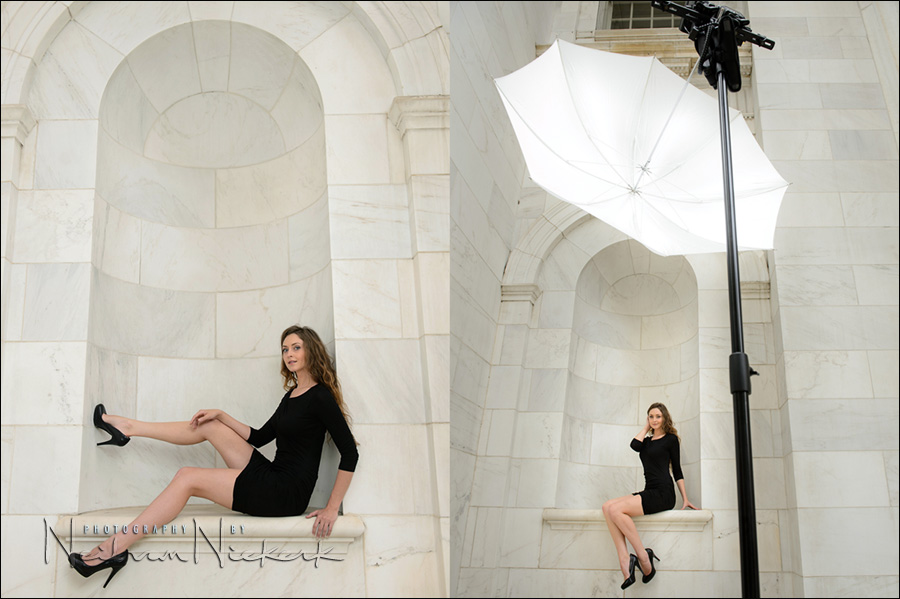
Flash photography questions & answers (FAQ)
Looking at some of the questions about photography that appear via Google searches, I wanted to more directly answer some of the questions. This article is a selection of questions on the topic of photography, that I decided to amalgamate into one longer article.
01) When to use flash in photography ?
Broadly speaking, there are two reasons you would use flash.
1. If the light levels are too low to get proper exposure, or eliminate camera shake or subject movement,
2. The light on your subject or scene is uneven,
then it makes sense to add flash.
Now, the decision as to when light levels are too low … or how far you’d risk camera shake and subject movement .. or whether the light on your subject is uneven .. these kind of things are open to interpretation. That said, I like clean open light.
02) Where to place the off-camera flash
As a very general rule, you can get great results placing the off-camera flash at about 30 to 60 degrees off from the camera’s point of view. It’s also a great starting point having the flash elevated by about 30 degrees over your subject’s eyes. This is very general advice though. But it would be a good starting point for a majority of simple lighting setups. From there you can (and should) experiment with light placement.
03) How to get catchlights in the eyes with flash photography
You can easily get catch-lights in the eyes when you bounce flash indoors, but considering the direction you want your light to come from. This also relates directly to the question above about the placement of off-camera flash.
When I shoot indoors, even in fairly large rooms, the catch-light in the eyes are there nearly predictably so. That article has more examples and discussion of the technique.
04) How do I test flash sync speed
An interesting question. First, you’d check your camera manual as to what your maximum flash sync speed is. Maximum flash sync speed is also the shutter speed where you can’t dial a higher shutter speed than around 1/125 to 1/250 (or 1/300) without going into high-speed sync (HSS) mode.
However, I feel that I should answer the question as wide as it was posed, and mention that you can sync your flash at ANY shutter speed slower than maximum flash sync speed as well. And if your camera is HSS capable, you can sync it as high as the camera and flash was designed for. (Although you have to keep in mind that there is a penalty in light loss.) Again, playing with your camera will tell you the answer.
05) Do I need to adjust my camera exposure with flash photography

Interestingly phrased – and the answer is, yes, to an extent. To an extent you don’t need to adjust your camera exposure when you use flash photography .. IF (and a big if) .. IF your ambient exposure is low enough.
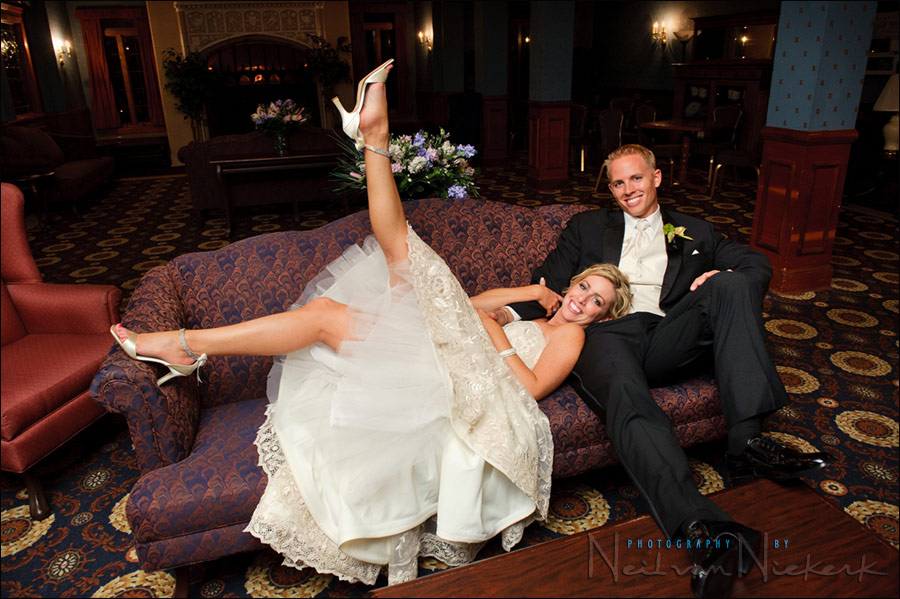
With this wedding portrait, my camera settings were 1/50 @ f4.5 @ 800 ISO, using TTL bounce flash.
The flash entirely dominates. It is in effect the only light source here. Since my ambient light levels are so low, I could’ve had a whole range of combinations of camera settings, and the TTL flash would still have taken care of the exposure.
In that sense, I need not adjust my camera settings. I could take numerous photos, and the TTL flash technology would take care of my exposure. It’s now just up to me to make sure my composition and timing and direction of light is good. So to a large extent, I could ignore my camera settings. But this only works when the ambient light levels are low. The moment the ambient light becomes more prominent .. eg, in brighter light, or because of my camera settings .. then I need to think more carefully about how to balance my flash with the available light.
This somehow segues into our next question, by way of contrast …
06) Flash output needed to overpower the sun
With manual flash, we have 4 controls for the flash exposure – aperture, ISO, power, distance. SInce the Sunny 16 rule tells us that we’re most likely in the region of: 1/250 @ f11 @ 100 ISO … this means we have to get f11 @ 100 ISO out of the flash, or more. We only have the flash’s power and distance-to-the-subject to work with then to get that f11 @ 100 ISO (or there-abouts). Since we’re probably working at full power anyway, or close to it … this then only leaves us the distance to work with. In other words, you have to get the flash close enough to your subject to give you that f11 @ 100 ISO (or more).
So for us speedlight shooters working in bright sun, it is usually not so much the flash output per se, but rather the distance between the flash and the subject. Oh, and while we’re on that topic, going into High Speed Sync mode will not solve your problem, but will worsen it … unless you have plenty juice to spare in your speedlight. Taking your shutter speed over maximum flash sync speed into high-speed flash sync, means less flash power.
Direction & Quality of Light
I wanted to distill the essence of what we, as photographers, work with – light! Before we can truly grasp on-camera flash and off-camera flash, and really, any kind of photography, we have to be aware of the direction and quality of light. We need to observe the light that we have, and then decide how best to use it, or enhance it.
With this book, I try my best to share those “aha!” moments with you, and I do believe this book can make a difference to your photography.
The book is available on Amazon USA and Amazon UK, or can be ordered through Barnes & Nobles and other bookstores. The book is also available on the Apple iBook Store, as well as Amazon Kindle.
07) Aperture controls flash exposure
Sometimes I feel like Don Quixote, tilting at this particular windmill … but really, aperture only controls flash exposure with manual flash. For TTL flash, there is an entirely different process at work. We really need to differentiate between TTL flash and manual flash, since for TTL flash, aperture does not control the flash exposure. When you hear someone say, “aperture controls flash exposure”, you just need to add the mental asterisk there yourself … *only for manual flash.
08) How to avoid shadows when using flash vertically

We can avoid that typical hard flash shadow, by bouncing our flash. Or using some kind of light modifier like an umbrella or softbox. But the method that is the most easily available to us indoors, is simple bounce flash.
If you do need to use flash directly, and need to shoot vertically, then your best option is a rotating flash bracket.
09) Why does TTL bounce flash need extra flash exposure compensation?
In theory, TTL flash exposure shouldn’t differ whether we shoot straight-on or with bounce flash. Keeping in mind that we need to stay within the range that the flash is capable of working in. Quite often we might be too close to our subjects when we shoot at a wider aperture. (Check the scale on the back of your speedlight.)
In practice we could very well find that we need to bump up the FEC a notch or two when bouncing flash. I take it to just be “one of those things”. Camera make and models vary. The algorithms they use to calculate flash exposure, all vary. So we could very well find that somehow we need more FEC with bounce flash. It’s one of those things we need to be aware of for our specific camera and flash, and then automatically adjust our settings for.
So why does TTL bounce flash need extra FEC some times? I don’t know. But I do know my cameras and adjust them accordingly, and get on with the photography.
11) What is the flash power setting for off-camera flash without a softbox
It’s impossible to give a direct answer to this. It really depends on what your ambient light is doing, and what you are trying to achieve with flash.
That said, metering for off-camera flash is most easily done with a flash-meter. If you don’t have a flash-meter, then the flash’s Guide Number will tell you what you need to know. Or just look at the distance scale on the back of your flash.
Since manual flash is dependent on:
– aperture
– ISO
– distance of your flash from your subject
– power setting
… it means we need to adjust our flash’s power output for the chosen aperture / ISO / distance combination. The distance scale on the back of the flash will tell us what we need to know to get close to correct exposure for our manual flash.
12) Increasing flash will eliminate ambient light
It doesn’t quite work the way as stated there. If you have correct exposure for ambient light, then adding (correctly metered) flash to this, will just over-expose the photograph. To eliminate or reduce the ambient light, you first under-expose your available light to a certain extent, and then add flash to give you correct exposure. Now you can progressively eliminate the ambient light by changing your settings, but keep your flash exposure such that you get correct exposure.
You would change your shutter speed first to reduce the ambient light, but usually not higher than maximum flash sync speed. Then you need to juggle the aperture and ISO settings … and add flash to this. This is the usual technique when your available light is ugly. Think of tungsten lights in the ceiling, directly overhead.
This question then neatly segues into the next question and answer …
13) What is the higher shutter speed to eliminate ambient light?
It’s not so much the higher shutter speed specifically, but a combination of your settings – aperture, ISO and shutter speed. By the time you under-expose by 5 stops, you’re not going to see much ambient light register. You could therefore eliminate your ambient light by changing to a small aperture and low ISO when you work in light levels that aren’t super bright.
Why 5 stops? Consider that changing your settings by a stop, double or halves the amount of light hitting the sensor (or film). Then, if you consider 18% as the middle tone .. then one stop down is 9% .. another stop down is 4.5% … another stop down is about 2% … another stop down is 1% … and another (the fifth stop down), isn’t much light at all.
14) Why is my bounce flash creating a shadow?
… because you insist on bouncing your flash forward at 45 or 60 degrees, or using a piece of plastic on your speedlight when you’re shooting indoors. More careful consideration of what you want to achieve with your light, is essential here.
15) Is there a problem having two catch-lights?
You know what? It doesn’t bother me. I am sure the more classical portraitist will have a conniption at this, but it really doesn’t bother me. I know, heresy!
16) TTL flash is not accurate when photographing darker people
… and I have to add that neither will it be accurate when photographing pale people in light colored clothes. TTL flash, and any other automatic mode of your camera, is dependent on your camera’s metering system … which tries to evaluate the scene & subject as seen through the lens. Therefore the camera (in this case with TTL flash) will be dependent on the tonality of the subject / scene.
Your camera is always trying to expose for the subject / scene as a mid-tone, and whenever the subject / scene is darker than average, your camera will over-expose (trying to expose for the darker subject / scene as if it is a middle tone. You need to interpret your camera’s metering display, and adjust accordingly. My recommendation will always be to shoot in manual metering mode. Then you have control.
On-Camera Flash Photography – revised edition
This book is explains a cohesive and thorough approach to getting the best from your on-camera speedlight.
Particular care was taken to present it all with a logical flow that will help any photographer attain a better understanding of flash photography.
You can either purchase a copy via Amazon USA and Amazon UK, or can be ordered through Barnes & Nobles and other bookstores. The book is also available on the Apple iBook Store, as well as Amazon Kindle. Also check out the Amazon Kindle store.
Learn more about how the cover image was shot.
17) Why can’t I use aperture priority with flash
Well, you could use aperture priority with flash, if / when:
– you make sure you stay at or below maximum sync speed, or
– you set your camera & flash to high-speed flash sync, and know that your flash output will be considerably reduced when you do go into HSS mode.
One of the cries for help I often see, is a photographer saying they get great available light exposures, but the moment they switch their flash on, they get over-exposed photographs. The reason for this is that they are using Aperture Priority, and getting settings like 1/1000 @ f4 .. but the moment they switch the flash on (without HSS enabled), the camera limits the shutter speed to maximum sync speed .. and they get over-exposure.
18) Why doesn’t my light meter display an accurate reading when using a speedlight?
Aside from the (small) chance of your light meter being faulty, the most likely reason why you might get a faulty or obviously incorrect reading from your flash meter when metering your speedlight’s output … is that you are shooting in TTL mode. Most flash meters are fooled by the pre-flash that the camera uses to determine TTL flash exposure (and the final output of the flash).
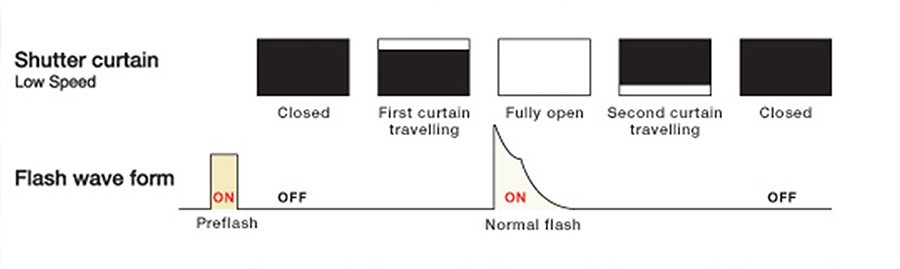
You can see the position of the pre-flash there, a low output burst of light from your speedlight. The camera senses how much of the light is returned, and from that will calculate the TTL flash exposure you should need. Hand held light meter readings are usually triggered by that pre-flash, and since it is lower in intensity than the actual output from the speedlight, will give you a reading that just doesn’t make sense. I drove myself crazy with this one weekend, when I couldn’t figure out why my flash meter would give me an f2.8 reading, no matter what aperture I set my camera to.
19) Pop-up flash photography techniques
Seriously, there are none. That plastic crap they want to sell to you to give you better light from a pop-up flash, is better spent as money going towards a better hot-shoe mounted speedlight. There are no short-cuts here. There is no good news I can give you about your pop-up flash, other than … you’re going shopping!
20) Flash outdoors without looking like flash
This is a tough one to give one definitive answer for. It really depends on what the light is like, and how you position your subjects in relation to the light.
The simplest scenario is where you position your subject so that their faces are in open shade, and then you just add a touch of fill-flash. The easiest way of doing this is to use TTL flash, and dial your flash exposure compensation down to around -3EV.
Where you have more uneven light, then using off-camera flash with a large diffuser (eg, softbox or umbrella), will give you the best looking results. The light from your flash will look really good, but I can’t say that it will be imperceptible as flash. Meaning, if you look at the image, then a logical conclusion about the light is that additional light like flash must’ve been used. But, it does look good!
21) Why two flashes with rear curtain sync?
TTL flash exposure is calculated with a pre-flash signal that the flashgun emits before the main burst of light. The main burst of light is what gives you (hopefully) correct exposure. But the camera needs some way of determining what that correct exposure should be. In order to do that, the camera measures the amount of light returned from that pre-flash. Looking at this diagram of the sequence of events when your shutter opens and your flash fires, you will see the pre-flash there:
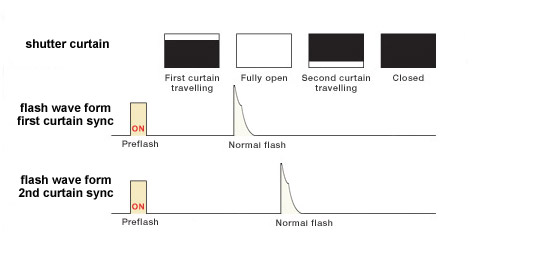
Now, if you set your camera to first curtain sync, then the pre-flash and main burst are so close together, that you can’t distinguish these as two discrete bursts of light. It looks like one blitz. Now, if you go to rear-curtain sync, and set a slower shutter speed … then there is a discrete time interval between when the pre-flash is emitted, and the main burst is emitted. You will see this pre-flash then as distinctly separate pulse of light.
You can test this for yourself by setting your camera to any aperture (but let’s say f4), and any ISO (but let’s go to 800 ISO just for this exercise) .. and set a 1 second shutter speed.
Set your camera to first curtain sync, and fire your shutter. You will see one burst of light. But when you now set your camera to rear curtain sync, you will see two separate blasts of light.
22) Benefits of 1/500 flash sync speed
A higher flash sync speed is a real boost when working in bright ambient light. The higher shutter speed implies a wider aperture, and hence more range on your flash.
An alternate way to look at it, is that in bright light, you have a better chance of over-powering the sun with a higher flash sync speed. The higher flash sync speed cuts more of the ambient light for the same aperture.
23) Difference between E-TTL / TTL flash and manual flash
The essential difference between manual flash and TTL flash, is that with E-TTL / TTL flash, the camera is calculating your flash exposure. With manual flash, YOU are the one calculating the flash exposure. This of course implies a whole bunch of other things, and this is where flash photography becomes confusing interesting.
24) How to intentionally under-expose with fill-flash
There was another version of this question: Is flash compensation the same as lowering your flash power?
Two questions with the same answer:
By adjusting your flash exposure compensation down, you are telling your camera and flash to tell you that you need less flash than the camera figured you do.
However, if you are using Manual Flash, then Flash Exposure Compensation doesn’t come into the picture. You need to manually lower your flash power, by dialing it down.
For example to change from 1/4 power to 1/8 power, you go through third of a step settings:
1/4 of full power,
1/4 of full power (minus) 1/3rd stop = 1/8 of full power (plus) 2/3rd stop,
1/4 of full power (minus) 2/3rd stop = 1/8 of full power (plus) 1/3rd stop,
1/8 of full power.
This is something you dial down on the back of your flashgun though, or on the power-pack of your flash if you are using the larger studio lights.
Then finally, an oddity perhaps:
25) I look terrible in photographs with camera flash
Really, that is an Google query that somehow pointed to my site.

The only answer I can give you, is to get photographer friends who read this site! ; )
Hi Neil,
And again this is a fantastic post! Thank you,thank you. The information you provide and the way how you provide it really improved my photography so much. You have a special gift as a teacher and I am glad you share it with us.
Recently I covered a wedding and did a few portrait shoots. The feedback I’ve got was fantastic! I am sure I would not be able to make the photographs I make today without your lectures.
How about a workshop in the Netherlands? I mentioned it earlier in a reply last januari. Really, normally I am not the kind of person who attend on workshops but for your workshop I gladly make an exception.
Thanks again,
Jeroen,
The Netherlands
Great Neil, I love you teach and tips all the time went I need to know something fast I looking on it.
Hello Neil,
i am watching your blog from one year let say. Daily i read 4-5 best photoblogs world wide. Your blog is one of the most interesting one, among the first two :). I really like to read the blogs of David Hobby (aka Strobist), the Ed Pingol blog, Joe McNally and Arias, plus sometime some diy photo blogs. And that’s all.
So, i never look in your site (maybe at the beggining when i was e noob) for the setup datas (aperture, exposure, iso, distance). No. Because never, and never and never again you can not duplicate this !!! Maybe it is better to understand why did you applied this setup or to understand the effect.
What it is important is to “see the light”, and you are doing this, you are explain to us how to see it and how to deliver it with strobes. It is important to understand why and how and after that you can realize something by yourself.
I am not a master in off-camera flash but with practice i want to become a better photographer.
It is very important that when somebody is reading your blog to understand something and “to leave the blog” with some new knowledges and to try to put those in practice.
From the days i started to make more interesting photographs without keeping in mind your exif datas.
Thanks Neil,
Marius
Hi Neil,
I love your site. I am following your blog religiously for more than 1 year now, every post every comment I read everything.
I would like to say you thank you for sharing your knowledge! I become better photographer because of you!
I have one question. How many cameras do you carry on you during the wedding? I use to carry two, but because they were hitting tables, I broke hot shoe on both cameras.
Thanks a lot.
Vlad.
Vlad .. I do carry two cameras on me for most of the wedding day. Not having the cameras be a danger to others or to the cameras themselves, is all in how you carry the camera over your shoulder. Don’t have the lenses protruding outwards or forward. Flip the camera around in the way you sling the camera over your shoulder and have the lens pointing behind you. It’s easy then to half -tuck the lens behind your hip, with the flash turned to follow your body contour. I will have to add this as a separate blog post with a photo.
Neil,
If I use the SB-900 as a commander to trigger another SB-900, does that SB-900 use the same filtered light that the SU-800 does (you mentioned that the SU-800 does not send an infrared signal to the slave units but a color-filtered light)? I’m trying to decide whether to skip the SU-800 and get a second SB-900.
The communication signals from the SB-900 is in the visible spectrum, just like every other flashgun. And yes, it would make more sense to buy a second SB-900 rather than an SU-800.
Hello Neil
First of all Neil I have read your book and that is what has inspired me to follow your blog. I wanted you to know I enjoyed the Q & A and wanted to let you know that I have shared your blog with several other photographers that I know and have suggested you and your material as a teaching tool. I am a OCFG. Off Camera Flash Guy. Have a great day and I will spread the WORD
Derrick .. thanks!
I guess I’m an OCFG either way ..whether an on-camera flash guy; or off-camera flash guy.
Hi Neil
I am on my second read of your excellent book, may I please ask a question.
If your scene dictates that you shoot in harsh direct sunlight, how do you tackle this, in particular at a Wedding where speed may be needed
Would you use fill flash on camera to lift the shadows and dial in some exposure comp, or would you try to get the flash off camera
Thanks, this blog is my source of inspiration
Phil .. a related article, although distinctly not a wedding, on overpowering the sun with flash.
How I deal with the harsh light depends on how the sunlight falls on them, and whether they are backlit. Here’s another article on dealing with bright sun and using on-camera flash.
Off-camera flash is always a good idea, except as in cases like the example discussed in that link. As always, we have to adapt depending on the situation.
Hello Neil, I’m trying to use ttl flash like you suggest. But it is acting like manual flash. I mean I am getting too much power even with low iso.
You say ttl is supposed to work toguether with the camera. I have a 530ex ii but ettl does work.
And if you can can you please write about function 05-3
thanks
Jorge .. there could be a few causes for your problem.
I suspect the most likely cause of the problem is one of range. You’re simply too close to your subject for your chosen distance. Especially if you’re using direct flash, you could be too close for the camera to react in time to cut the light from the flash. Check the distance scale on the back of your flash if you’re using direct flash, to see what the range is.
Alternately, you might have your FEC set to a positive value, thereby always blowing out exposures.
Then there is also the (small) chance that your flash or camera is faulty.
I don’t have the 530EX, so I don’t know the custom functions. Sorry.
Hello Neil,
I usually shoot portraits and weddings and try to implement the bounce techniques that you have discussed in your articles. It works well for me almost every time and am quite happy with the learnings that i had so far from your articles. However, when i bounce flash or flag it, I see that I don’t get good catch lights. the catchlights are very weak and are not sharp and definite in shape.
Am I doing something wrong or my way of bouncing flash is incorrect?
Anil … it is most likely to do with your angle that you bounce your flash. I suspect you’re still bouncing your flash too high up. (Difficult to guess without a sample photograph.)
This post was funny and great! The reason why it was great was because I just faced the issue you mentioned above on this page “increasing flash will eliminate ambient light” when I was at a party yesterday.
When I got home and looked at my pictures, my efforts on the scene to get rid of the ugly florescent overhead lights while shooting with flash just didn’t work well enough. There’s an ugly greenish tint everywhere.
I thought to myself, “Let me jump over to Neil’s web site and see if there’s anything about this”. And coincidentally, it was on the front page!
I tried what you mentioned above and it worked perfectly when I just tested it in my house.
Another tip of the cap to you!
John
I did see one useful function of the pop-up flash – strictly as a flash commander. But other than that, ya, I wholeheartedly agree with you. ;)
“I look terrible in photographs with camera flash” HAHAHAHAHAHA. OMG. People will google anything.
But seriously, Everytime I go anywhere and shoot any kind of gathering/reception/party etc, the end result is always,
“How are your photos always so crisp and clear and bright(well exposed) and you dont use a flash”
This is followed by “Huh”, I do use flash, on every one of those images, flash was used. Do you not remember it going off all night and that huge Quantum turbo pack on my hip.”
“But it doesnt look like flash was used” This means I did my job.
And of course the others who say, “Uh shouldnt your flash face forward, you got it going off behind you dude haha”
As you said, get some friends who know how to use flash. For me, flash gives me more control over the scene. Without it, we only control ambient. With it, we can control both subject exposure and ambient(or background) so we get a more balanced image that doesnt look like the typical P&S snap where kids blown out in front of a cave
Neil, believe it or not, there are true professionals who cant use flash the right way. I work with some thats worked in this business 25yrs and still get asked, “Did you use your softbox in the livingroom”
No!
“But how did you get short lighting on her if you used on camera flash, must have been North window light”
No! ON CAMERA FLASH. No window on that side.
“But how”
Ding ding ding. Bounce flash on wall and….wait for it……”Black Foamie thing”
As far as the whole TTL and light meter thing, we shoot in manual to avoid the whole TTL mess. I think we value the predictability of manual. While it may seem slower at first, once you get your flash settings right, it’s actually quite a bit quicker.
Hi Neil.
In regards to the first question on this post, I can’t see any logical reason to use a flash meter to set exposure when using TTL flash mode… the flash/camera will adjust the flash power output as needed to achieve a correct exposure given a user selected lens aperture/ISO/shutter speed combination; that is what TTL is designed to do. The way to adjust exposure here is with the FEC (flash exposure compensation) button.
I ONLY use a flash meter when I shoot with my speedlights in manual mode; here I am in control of selecting flash power output (and/or distance to subject) to achieve correct exposure given a aperture/ISO combination.
Am I missing something here?
Cheers,
C. Arche
Carlos .. you’re entirely correct. But why I (and I assume others) have tried to use a flashmeter, is to try and see if the flashmeter agrees with the amount of light put out. In digital times it seems superfluous with the instant feedback of the camera’s preview. When I tried it to figure out what the camera was doing, was when I was shooting slide film … no feedback, and no latitude.
I used to shoot slides years ago so I am aware of the limited exposure latitude of this media. If needed, a flash meter should work fine with any old (film) camera using the original version of TTL which had no pre-flash. With Canon film cameras using A-TTL, you should be able to get an accurate flash exposure reading by half pressing the shutter (this is when the pre-flash occurs in this system), then activating the flash meter before taking the final exposure to measure the actual flash exposure.
With E-TTL (digital SLR’s don’t have TTL or A-TTL modes, those are only availble on film bodies), you can use the flash exposure lock (FEL) button, this will trigger the pre-flash and lock the exposure. Then activate the flash meter and take the photo – this will prevent the pre-flash from firing during the actual exposure as the camera has already made and stored all the relevant flash calculations.
BTW, using FEL with fill flash can help prevent subjects closing their eyes do to the pre-flash.
Cheers,
Carlos
Hi Neil,
I just read your “Photographing a model in Hoboken” article and am intrigued by the softbox’s versatility! Can you share some insights on which scenarios would you use a shoot-through umbrella vs. a portable softbox? I can see that there’s potentially more light spill with an umbrella, so when would it be preferable to a softbox? Thanks for any thoughts!
Kenneth … here is the blog post with comparison images between a softbox and umbrellas.
Hi Neil.
Back to question 1… The Googler may be referring to their camera’s built-in light meter rather than a separate flash meter. If they are shooting in low light in aperture priority with metering set to evaluative, they may be getting a higher shutter speed reading with the flash switched on. In Canon Land, (where aperture priority + flash = slow sync by default) this is the method used to avoid over exposing the subject in low light. This works hand-in-hand with evaluative flash metering in daylight, where the flash power is reduced when the ambient light reaches a certain level.
I’m sure Nikon cameras have something similar with matrix metering, TTL-BL and slow sync selected.
Allen … quite true. On re-reading the search engine query, it could’ve referred to the camera’s built-in meter as well.
My typical workflow for difficult lighting situations:
– Snapshot in P-mode, Av-mode or Tv-mode
– Take over the settings in M-mode
– Up and down clicks for aperture, shutter speed and ISO depending on the snapshot, e.g.
. + or – EV clicks to add/reduce exposure
. +EV clicks on one setting => -EV clicks on another setting (thus a constant EV)
Counting clicks is easier than watching numbers or zeroing the needle.
re: focusing assistance with flash off the camera
If you are accustomed to using a flash bracket, the Nikon SC-29 off-camera shoe cord has AF assist built into camera connector. You can’t get that with Canon ;)
In “flash output needed to overpower the sun,” everything Neil has said is true. However, there is one other option if you must use speedlights to overpower the sun and you end up in high speed sync mode. Neil has a blog entry here:
https://neilvn.com/tangents/using-multiple-speedlights-with-high-speed-flash-sync/
Yes, you need multiple speedlights. One will not be enough for the reasons Neil stated. You are compensating for the loss of power of an individual speedlight in high speed sync mode by having multiple speedlights in high speed sync mode collectively produce the light needed. Joe McNally is famous for his crazy multiple speedlight setups.
.. or, simpler yet than multiple speedlights, use a neutral density filter when you would otherwise have ended up in the higher shutter speed ranges, but still giving you wide apertures.
Neil,
Any inputs on when to use SB-900 illumination pattern mode ?
John
John .. with the SB-900 I keep them to Standard illumination pattern.
I very rarely use direct unmodified flash as the main source of light. Indoors I usually bounce my flash, and on location I use softboxes and such. Therefore the actual illumination pattern doesn’t really matter.
I suppose that using Center-Weighted illumination pattern might give marginally stronger flash since it is more concentrated towards the middle of the area that the flash is pointing to. For simplicity though, I keep to the defaults on all my SB-900 units.
Hi Neil
What do you think about this:
P: Programmed Auto
In the P exposure mode, the camera picks both aperture and shutter speed automatically to obtain a proper level of exposure.
For example, one reading in a dim light gives me 1/13s f/1.8 at ISO 400. When a Speedlight flash is mounted on the hotshoe or the built-in flash is popped up, the shutter speed is automatically changed to the flash shutter speed (typically 1/60s but can be changed via Custom Settings Menu). What happens to the aperture? It goes from f/1.8 to f/4. From 1/13s to 1/60s is 2 and 1/3 stop under exposure and from f/1.8 to f/4 is another 2 and 1/3 reduction in exposure. In total, the camera decided to underexpose the ambient by 4 and 2/3 stops. The flash is expected to make up the difference to bring a proper exposure to the main subject.
In another example, the camera meter reading was 1/125s f/5.6 at ISO400. When the built-in flash is popped up, the exposure changes to 1/250s f/4. There is no change to ambient exposure.
I find this in http://dptnt.com/2010/01/balancing-flash-and-ambient-exposure/
Why you dont use this type of information in your two excelent books?
Regards
Victor .. the problem, for me, in working like this, is that I would have to think about it, and check how the camera is responding. Now, instead of Program mode making my life easier, it makes the thought-process just a touch more involved … certainly more involved than using manual exposure mode on the camera, and then adding TTL flash to it.
Sorry Neil for my english.
My mind is technical, I am chemical engineer, so always try to understand how the things work. In this case, I am not saying P is better than manual mode, only mention that there is an explanation more elaborate on P, than you use in the books.For me is important, may be for others persons no.
Regards
Consider this bookmarked and shared…
Rudy
I purchased your first 2 books about off camera and on camera flash. The first one has helped me greatly in my location portraiture work. Thank you for the helpful posts.
I have come across your blog a few times, and I wasn’t advanced enough to understand it. This post speaks volumes for me. Thank you so much for generously sharing your expertise. I’ll be following you.
BTW I came here from a tweet posted by B&H in New York City.
Best,
Marie
I am looking at purchasing a light meter. Its a sekonic L-308s. Now this light meter and others like it has ability to measure ambient light with shutter speeds of 1 sec – 1/8000. But for HSS Flash it is 1 sec – 1/500. So would a shutter speed higher then 1/500 using HSS Flash cause the light meter to give inaccurate results? Has anyone tested it? I am hoping to use a light meter for fill-in flash during daytime.
Cristo,
Just to clarify, you cannot measure flash if using TTL mode on flash, it must be in manual flash mode only that it can measure accurately since the pre-flash of TTL causes the flash meter to try to register that pre-flash which would cause it to think it’s massively under-exposed, or in my tests (inside house) when I went to TTL, failed to measure at all with ‘EU’ coming up on meter meaning it cannot read exposure value at the pre-determined ISO/Shutter I had set.
Once again about TTL, you need to use Manual Flash, but having said that, you can go to 500th sec., manual output and get a correct reading yes.
Yes, the Flash Meter’s ambient light will go to 1/8000th, but flash meter only to 1/500th so don’t know precisely if accurate measurements would be obtained above 500th.
Now, I just tested my flash, (SB900/Nikon body) manual mode, inside with wife holding my L358 which I have – not the 308 – and my shutter set to 500th, ISO 800, and it gave me a reading of f6.3 (direct flash only 2.5m from subject) and it gave an absolute perfect reading, I had a white object in frame also, then I dropped my aperture to 5.6 and it started to show highlight warning of white object so it was dead accurate.
I then switched up to 1000th sec shutter, flash manual on camera still straight at subject, and it then gave me f3.6 (meter set in 1/10ths) so I went to f3.5 and once again perfect exposure.
So you will need to consider that once using a Flash Meter, your flash needs to be in manual mode and maybe even your camera’s Sync Speed will determine your highest shutter speed setting to get accurate results since I don’t know my L358 specs but it seemed to work great firing many tests different ranges, different ISO, different shutter speed (all above 250th) and each time perfect exposure, with NO black banding at bottom of frame.
Later, I even bounced the flash, manual mode, took reading, changed aperture to meter’s measurements, perfect once again. Of course, anything in background started to disappear quite quickly in the ambient range only and only my wife’s face and all other things in same range showed up with correct reading.
Hope this helps.
Cheers,
Trev
Thank you Trevor for you kind help with this one. I think I understand a little bit more how these flash meters work